Monday, May 31, 2021

After the morning session, a lunch break, and the deposition resumes in the afternoon:

                                                           
Door heard opening...


(Napoleon After Waterloo)


-6 P.M.

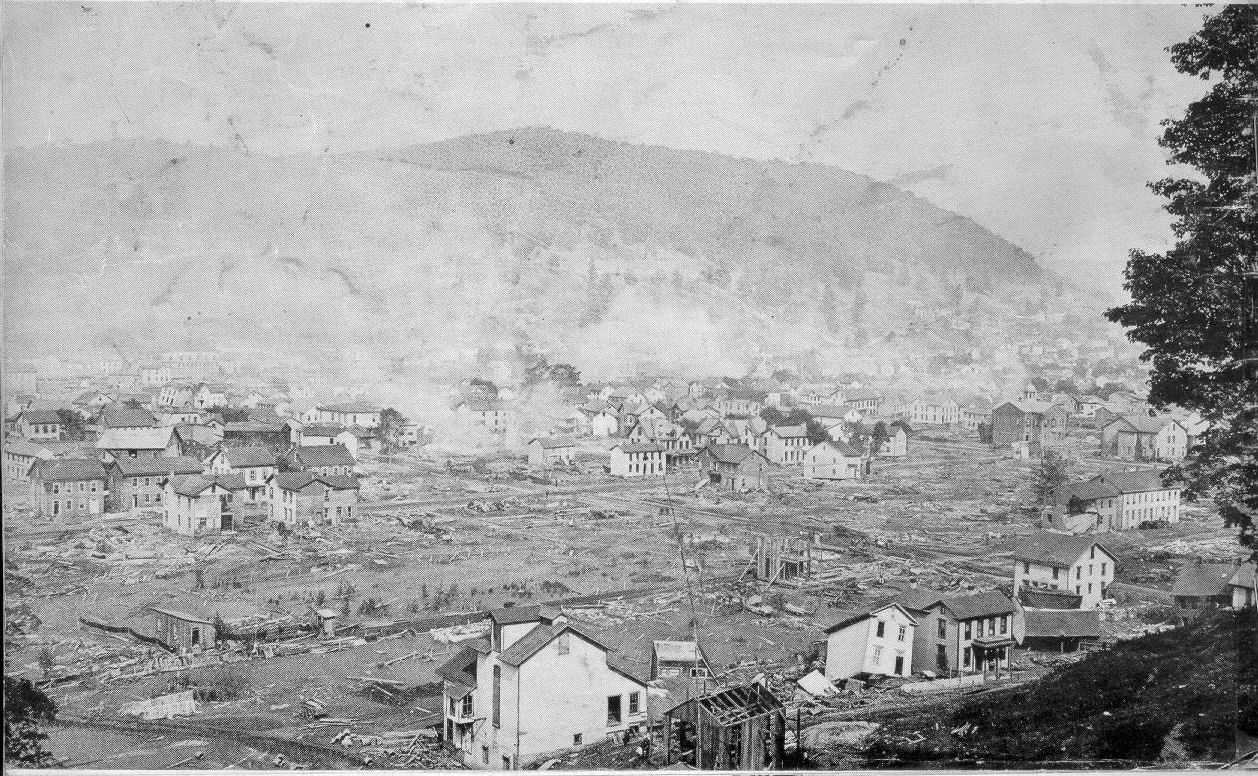
 ...by six o'clock the whole monstrous pile had become a funeral pyre for perhaps as many as eighty people trapped inside.
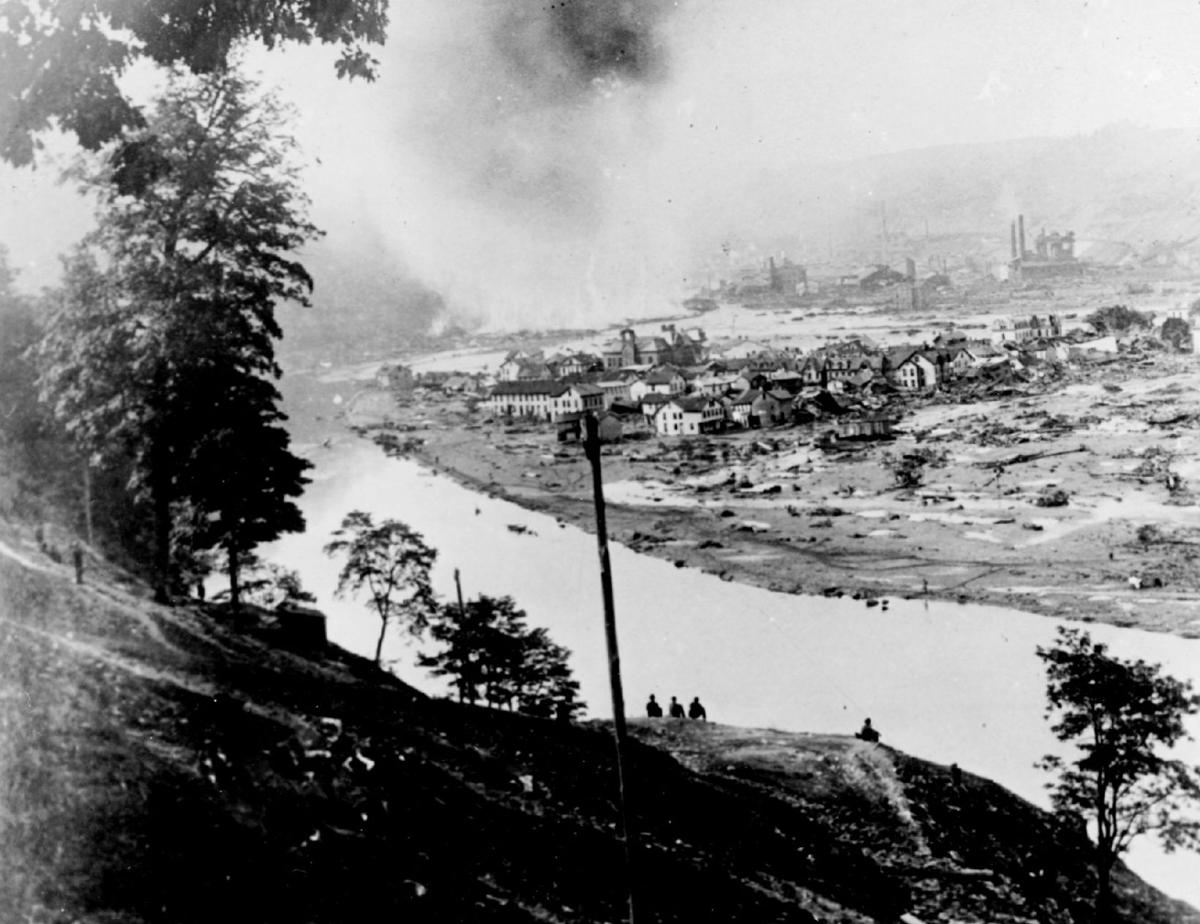
White smoke from the fire at the Stone Bridge on the Conemaugh River; Johnstown center, the Cambria Iron Works top right.

-4:15 P.M.

A LiDAR analysis of the Conemaugh Lake basin reveals that it contained 14.55 million cubic meters (3.843 billion gallons) of water at the moment the dam collapsed.


Modern dam-breach computer modeling reveals that it took approximately 65 minutes for most of the lake to empty after the dam began to fail.


-4:09 P.M.


So once again, for the second time within an hour, Lake Conemaugh gathered in a new setting.
(Ibid 149)

-4:07 p.m.

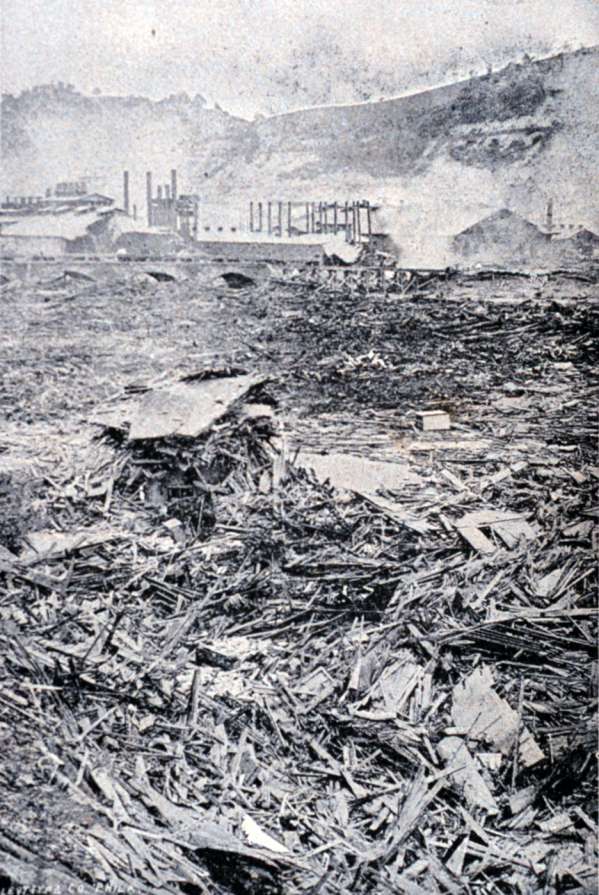
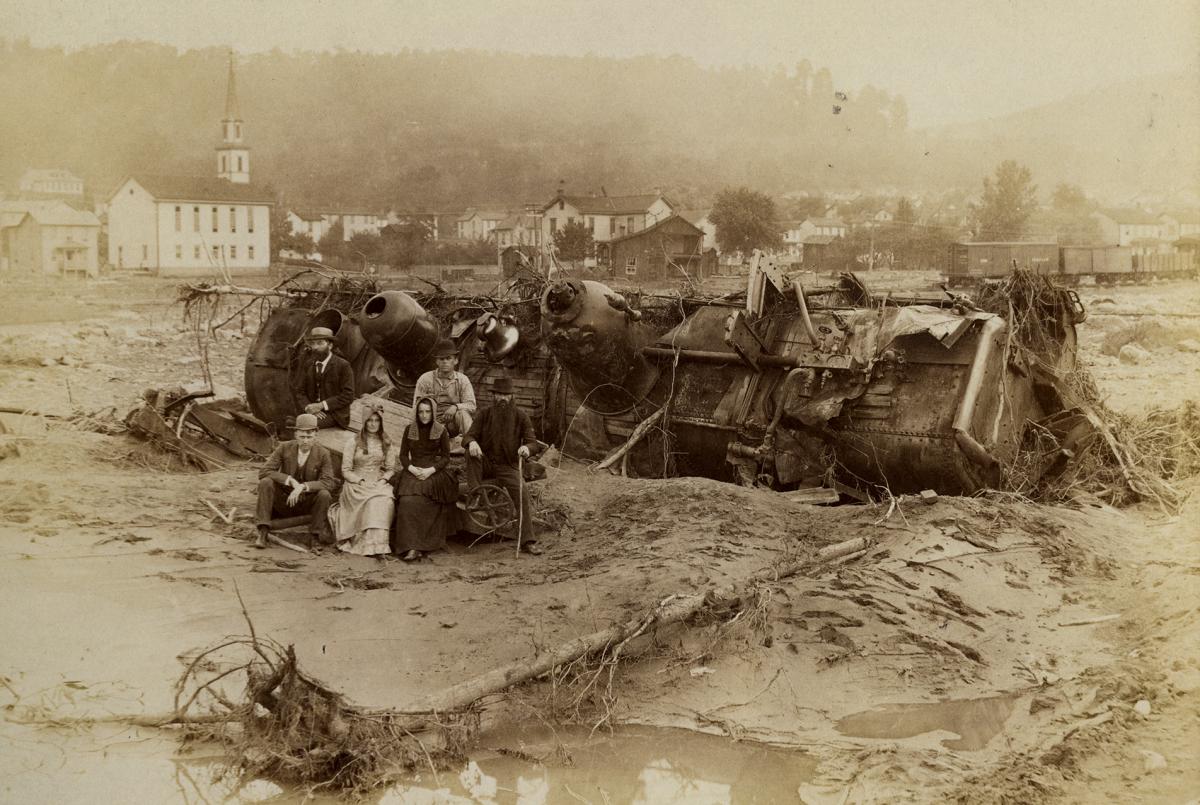
  ...the flood hit Johnstown. The residents were caught by surprise as the wall of water and debris bore down, traveling at 40 miles per hour (64 km/h) and reaching a height of 60 feet (18 m) in places.





-4:05 P.M.

 It was now not quite an hour since the dam had given way. The rain was still coming down, but not so hard as before, and the sky overhead was noticeably brighter.

In Johnston the water in the streets seemed actually to be going down some. It had been a long, tiresome day in Johnstown, and the prospects for a night without gas or electricity were not especially cheerful, but by the looks of the water and the sky, the worst of it had passed.
(McCullough 128)

-3:32 P.M.

But within seven minutes, the viaduct collapsed, allowing the flood to resume its course. However, owing to the delay at the stone arch, the flood waters gained renewed hydraulic head, resulting in a stronger, more abrupt wave of water hitting places downstream than otherwise would have been expected. The small town of Mineral Point, one mile...below the Conemaugh Viaduct, was the first populated place to be hit with this renewed force. About 30 families lived on the village's single street. After the flood, there were no structures, no topsoil, no sub-soil – only the bedrock was left. The death toll here was approximately 16 people. In 2009, studies showed that the flood's flow rate through the narrow valley exceeded 420,000 cubic feet per second (12,000 m3/s), comparable to the flow rate of the Mississippi River at its delta, which varies between 250,000 and 710,000 cu ft/s (7,000 and 20,000 m3/s).


...when this second dam let go, it did so even more suddenly and with greater violence that the first one. The bridge collapsed all at once, and the water exploded into the valley with its maximum power now concentrated again by the [six minute] delay...(McCullough 109)

...when the flood came, the wall of water swept through in such a way that it left almost nothing to suggest that there had ever been such a place as Mineral Point. The town was simply shaved off, right down to the bare rock. (Supra 111)

-3:25 P.M.

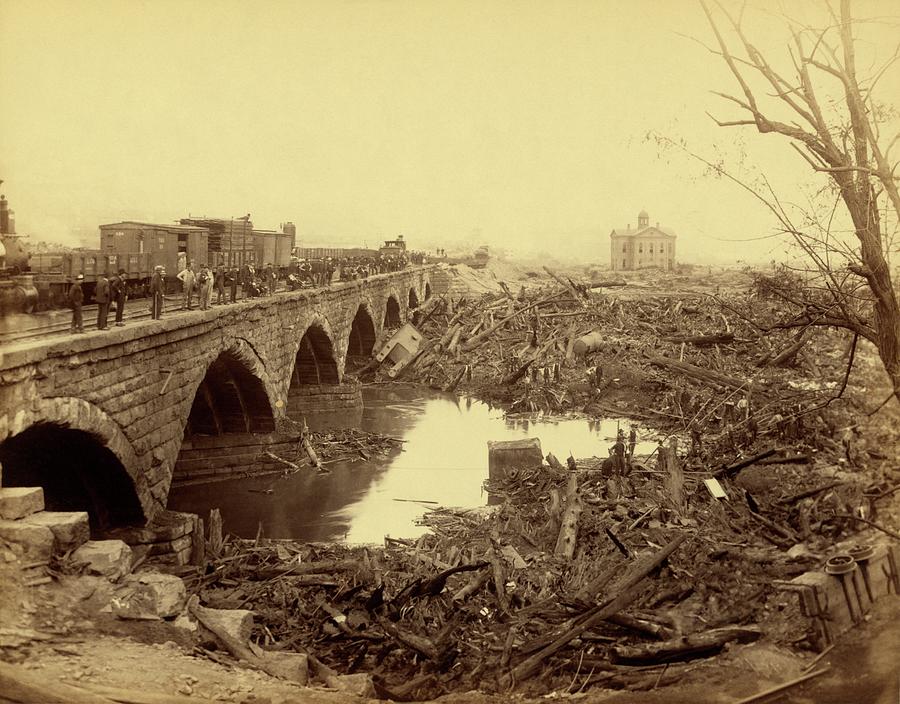
At the Conemaugh Viaduct, a 78-foot (24 m) high railroad bridge, the flood was momentarily stemmed when...debris jammed against the stone bridge's arch. 


It was here...that the water smashed into its first major obstacle, a tremendous stone viaduct...built more than fifty years earlier...

The viaduct was one of the landmarks of the country. It stood seventy-five feet high...Even the biggest locomotives looked tiny by contrast as they chugged across it on their way up the mountain.
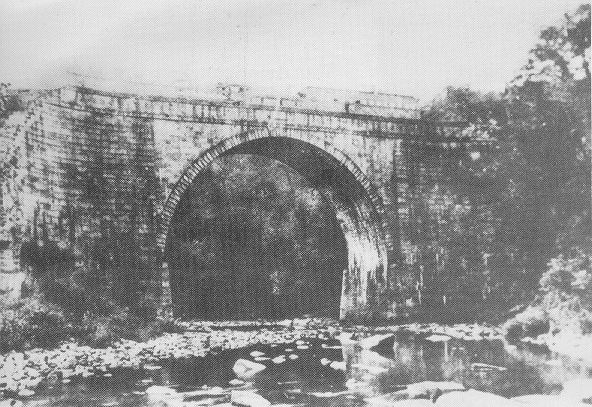


Now, for [six minutes], Lake Conemaugh formed again some five and a half miles downstream...It gathered itself together, held now by another dam, which however temporary was nonetheless as high as the first one...(McCullough 108-9)

-3:15 P.M.

 "At 3:15 the Central Telephone office called the Tribune to say it had been informed by Agent Deckert, of the Pennsylvania Railroad station, that the South Fork Reservoir was getting worse all the time and that the danger of its breaking was increasing momentarily. It is idle to speculate what would be the result if this tremendous body of water--three miles long, a mile wide in places, and sixty feet deep at the breast at its normal stage--should be thrown into the already submerged Valley of the Conemaugh."-Swank.

No need to speculate, Tom, no need a'tall.

-3:10 P.M. May 31, 1889, Lake Conemaugh, South Fork, Pennsylvania

[Dan] Boyer said, "It run over the top until it cut a channel, and then it ran out as fast as it could get out. It went out very fast, but it didn't burst out."

John Parke said, "It is an erroneous opinion that the dam burst. It simply moved away."

According to Ed Schwartzentruver, "The whole dam seemed to push out all at once. No, not a break, just one big push." (McCullough 100)


It is, therefore, safe to assert that the flood which poured through the break in the South Fork dam each second was equal to that which in the same space of time rushes over the Falls of Niagara.
...
...the total energy of the water was that of 20,000,000 tons falling 404 feet [onto Johnstown].


-3:00 P.M.

 "At three o'clock the town sat down with its hands in its pockets to make the best of a very dreary situation. All that had got out of reach of the flood that could, and there was nothing to do but wait..."-George T. Swank, editor, Johnstown Tribune.

Tom didn't get the memos, ambiguous though they were.

-Near 3:00 P.M.

Beginning about three in the afternoon of Memorial Day, unprecedented amounts of rain fell in the mountains [of Western Pennsylvania] for from twenty-four to thirty-six hours.

Deckert was not perfectly cool about it. Deckert had a Western Union operator call her office on the telephone and read them the contents of Wilson's "dam may possibly go" telegraph. (McCullough 97). Much too ambiguous a message to be rushed through in haste. ~Twenty minutes to break, much too late for Johnstowners to act on whatever they thought the message was advising them to do.

-2:45 P.M.

Wilson's last telegraph that the dam "may possibly go" received in Johnstown by ticket agent Deckert. Thirty minutes away from breaking...

-2:33 P.M.

Wilson's cool, ambiguous last telegraph was received in East Conemaugh. The dam was forty-two minutes from breaking.

-2:25 P.M.

Wilson heard that a kid named John Baker had just come from the dam and said the water was cutting a notch in the face of the dam. It's too late now even for an "EVACUATE!" message to be sent and received in Johnson but this message that Wilson sent to Pitcairn at 2:25 PM is absurdly "cool" and ambiguous.

                                                                                           SOUTH FORK, MAY 31, 1889
R.P.
OD
THE DAM IS BECOMING DANGEROUS AND MAY POSSIBLY GO.
                                                                                                           J.P. WILSON


-1:52 P.M.

The AO tower between Mineral Point and East Conemaugh.


Wilson was not perfectly cool about it. From South Fork Wilson had another telegraph sent to Pickerell in Mineral Point which Pickerell received at 1:52 and sent on ahead to East Conemaugh, Johnstown and Pittsburgh.

                                                                                                    SOUTH FORK, MAY 31, 1889
R.P.   [to Robert Pitcairn]                          O.D. VIA MP [Mineral Point] & AO [tower]

THE WATER IS RUNNING OVER THE BREAST OF LAKE DAM, IN CENTER AND WEST SIDE AND IS BECOMING DANGEROUS.
                                                                                         C.P. DOUGHERTY

So one sees that Wilson's commensurate body temp with the circumstances was not channeled into a message, and that to Pitcairn, not Johnstown, that was an unambiguous, e.g. EVACUATE! message. "IS BECOMING DANGEROUS," is too "cool" for the circumstances.  We are one hour and twenty-three minutes from Lake Conemaugh being channeled into the valley, destination Johnstown.

-12:55 P.M.

Pitcairn's man, Wilson, had his own man, Siebert, who reported back to Wilson that a body of water fifty to sixty feet wide had started over the crest of the dam. Siebert was "perfectly cool" about this.*

There was nothing about the condition of the dam the entirety of May 31 to be "perfectly cool" about. However, even if Siebert had had the body temperature commensurate with the circumstances and reported it with the warmth of alarm, it was getting very late in the day for excitable to make any difference.


*There is a fifty-seven minute gap in the timeline where there should not be a gap. The timeline taken or reconstructed from McCullough is picked up to 12:55 p.m. The next entry, next post, is 1:52.  This is getting very close to nut-cuttin' time, there was surely much activity at SFFHC, but the activity is not put with a time for almost one hour.

-12:30 P.M.

From Pittsburgh Robert Pitcairn sent a man of his own in South Fork to check on the condition of the dam. (Ibid 95)

-Between Noon and One O’Clock

The wires being down beyond Mineral Point, Pickerell "waited and waited" for someone to come past who could hand deliver his message to the next station over, East Conemaugh.

A railroad worker finally came by, Pickerell gave the message to him. The railroad worker gave it to his foreman at Buttermilk Falls who had the message sent by telegraph to East Conemaugh, Johnstown and to Robert Pitcairn's office in Pittsburgh. The message was received at those places between noon and one o'clock. (Ibid 93-95)


-Noon, Johnstown

"As we write at noon, Johnstown is again under water, and all about us the tide is rising...From seven o'clock on the water rose...On the water crept, and on, up one street and out the other."-George T. Swank, Johnstown Tribune (Ibid 83)

...a man came up into the [telegraph] tower [at South Fork] "very much excited."

"Notify Johnstown right away about the dam. It's raising very fast and there's danger of the reservoir breaking."

South Fork telegraph operator Emma Ehrenfeld,

was not quite sure how much to believe of [the man's] story. She thought his name was Wertzengreist, but was not sure. At any rate,"He is a man that people generally don't have much confidence in, and for that reason, I scarcely knew what to do..."

Miss Ehrenfeld telegraphed the operator at Mineral Point, W.H. Pickerell, what he thought should be done. Pickerell said,

"It was a thing that there oughtn't to be any risks taken on"  and wrote the message himself. 

SOUTH FORK DAM IS LIABLE TO BREAK: NOTIFY THE PEOPLE OF JOHNSTOWN TO PREPARE FOR THE WORST.-Operator
(Ibid 87)


That is a reasonably clear, and if Johnstowners had received this "notification" within a minute or so of it being sent, they would have had enough time to do what they thought they should consistent with preparation for "THE WORST."  But it was not received in Johnstown, much less disseminated to the citizenry, until it was too late to do anything about.

-11:30 A.M., Lake Conemaugh

Water began washing over the top of the wall at 11:30 a.m. Parke set out immediately to warn the people in South Fork—two and a half miles away. (Shappee 84)*


*I originally had this posted at 12:45 p.m. although there was conflict within McCullough at 93, 95 and 98. Then I read Shappee above, consistent with McCullough 93, and decided to go with 11:30. I also favored Shappee on the order of water running over the top and Parke's ride because of the confusion in McCullough. The latter has the ride happening before the water ran over the top (93 and 98)


-11 A.M. Johnstown, Lake Conemaugh

The water by now, from one of town to the other was anywhere from two to ten feet deep. (Ibid 82)

At Lake Conemaugh, 

...the water was about level with the top of the dam and had already started to eat into what little had been thrown up by the plow and shovels. On the outer face, near the base of the dam, it looked as though several leaks had developed.

At this point, Colonel Unger decided that perhaps something ought to be done to warn the people in the valley below. The only way was to send a man down...

...John Parke made the ride [to South Fork, the nearest town] in about ten minutes. Parke's relative youth, and...furthermore...that Boyer and Bidwell had already told everyone that there was no danger of the water running over the top...account for the marginal success of [Parke's] mission. 

Parke also told two men to go to the railroad's telegraph tower...and tell the operator to alert Johnstown...(Ibid 93)

-10 A.M., Johnstown


By ten there was water in most cellars in the lower part of town. School had been let out, and children were splashing about in the streets with wooden boxes, boards, anything that would make a boat. (McCullough 79)

-9:55 A.M., Lake Conemaugh

Col. Unger sent his man, Dan Boyer, caretaker of the S.F.F.H.C. grounds, to recall the team of immigrant Italian laborers who had been working on throwing up mud and straw to raise the crest of the dam. Unger now wanted the men to dig another spillway. The Italians objected that a cut in the dam now would cause it to collapse.

"It won't matter much," Unger said, "it will be ruined anyhow if I can't get rid of this water."*

*Here it is then, the first positive statement by a S.F.F.H.C. person that the point of no return had been reached. Unger knew, John Parke knew, that there was no way to "get rid of this water" without a controlled break of the dam. If clear, unambiguous--"EVACUATE!"--warning had been sent down the valley, and received, at this hour, people could have saved themselves. Instead, ambiguous warnings were sent only later.-BH

-9:30 A.M., Johnstown

About then the rain started coming down again as hard as it had during the night, heavy and wind-driven...For another half-hour he and the boys set about placing his papers and other things well above the flood line of 1887, which was about a foot from the floor. (Ibid 81)

Texas Democrats Stymie G.O.P. Voting Bill, for Now

(NYT)

-9 A.M., Johnstown

...somewhere near nine, the water that far downtown was too deep to get through safely. (Ibid)


-8:30 A.M., Lake Conemaugh

[S.F.F.H.C. member] D.W.C. Bidwell, who evidently had had enough of the soaking weekend at the lake, stopped to ask [Col. Elias J.] Unger [manager of S.F.F.H.C.] how things were going.

"Serious," answered Unger, who later that morning was heard to say that if the dam survived the day, he would see that major changes were made to insure that this sort of thing never happened again.  (Ibid 92)*

*”Serious”; “if the dam survived.” That is an ominous adjective and an ominous contingency, which Unger knew he could not ensure now. There was a failure by those associated with SFFHC to warn Johnstown throughout this cataclysmic day, in public tones that matched their private sentiments. By the time they did wires were down, it was too late in any event, and Johnstown was hit completely unawares. If at this hour, clear, unambiguous warnings had been sent down the valley by people like Unger in a position to know, Johnstown could have saved itself. They were not and it never had a chance.

-7 A.M.

When the seven o'clock shift arrived at the Cambria mills, the men were soon told to go home and look after their families. (Ibid)

-6:30 A.M., Lake Conemaugh


The hard, cold rain that had started coming down the night before had eased off considerably by the morning of Friday, May 31. (McCullough p.79)

It was about six thirty that morning when young John Parke awoke in his high-ceilinged room upstairs at the clubhouse...He had awakened once before, about an hour earlier, and had heard the rain hammering...but thinking nothing of it, had dropped off to sleep again. ...

Parke dressed quickly, went...out the porch door,...where, for the first time, he heard...a "terrible roaring as of a cataract" coming from the head of the lake to the south. He also noticed that during the night the lake had risen what looked to be perhaps two feet. (Supra 89)