Thursday, August 31, 2006

Murder Case Photographs- #13


Murder Case Photographs- #13

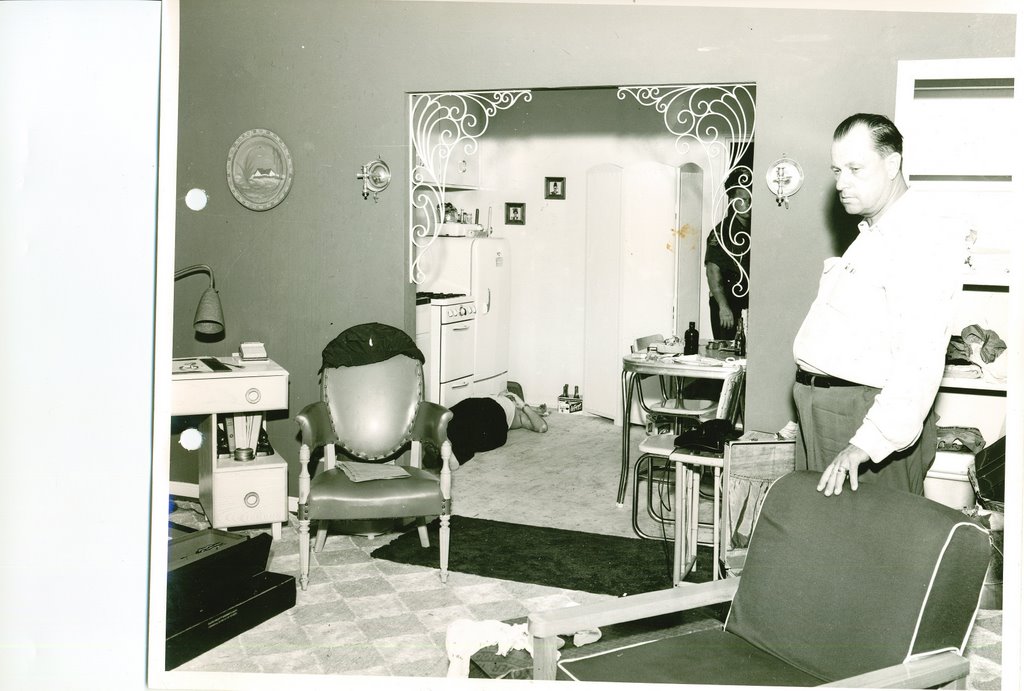
"Sally's Do Drop Inn." "Do Drop"-"Dew Drop," get it?

The "Do Drop Inn" is gone, and so is the unsophisticated, charming culture that produced such cornball names. A few years ago in a simple, slow vacation town there was a sign for a Chinese restaurant, "Takee Outee." Same thing. Now we're hip, cutting- edge. Now our watering holes have names like Xanadu and Oasis and our murders are committed with AK-47's.

The location of this bar is now an urbanized intersection crowded with gas stations and fast food restaurants. The brown tinge to this photograph makes the bar look like it's caught in a dust storm and even more isolated than it was.

-Benjamin Harris

Wednesday, August 30, 2006

CNN: "New GOP Buzzword: Fascism"

CNN: "New GOP Buzzword: Fascism"

There has been a change in official language in describing la cosa nostra with Islam. As was posted about here* British Prime Minister Tony Blair recently redefined the post-9/11 world as a "struggle" over whether "our values can beat theirs." Then on August 10, President Bush reinforced Blair's redefinition by stating that the conflict was with "Islamic Fascists."**

Gone was the silly lumping of Islam's war against the U.S. with (1) North Korean psychopathology (2) Basque separatism (3) IRA terror (4) Chechnyn independence, (5) an abstraction, "Chaos", et al. Both of these vanguard leaders now view, talk about, and force their nations to think about this issue as a dichotomy between Islam and the U.S., England, and Israel.

An article on CNN.com today under the headline above reported on this critical rhetorical change, helping to insert it into the public consciousness. It will take scores of speeches and articles for the redefinition to be the subject of popular discussion but an important change has occurred. This is Public Occurrences.

*Tony Blair's Speech in Los Angeles: Public Occurrences, August 1, 2006.
**President Bush on "Islamic Fascists": Publocc, August 10, 2006.

Tuesday, August 29, 2006

Karen Armstrong's "The Great Transformation"

Karen Armstrong's The Great Transformation.

In one of The Teaching Company's philosophy tapes on Emmanuel Kant the lecturer says that the "categorical imperative" is really just The Golden Rule restated. For a listener it was a jarring--and funny--thing to hear. "That's it? He must have felt foolish to have wasted all of that time and effort writing. I feel foolish at having spent the time I did trying to understand."

That statement stuck with me. It was a check on getting too impressed with the works of a "Philosopher," and with difficult reading. It was a reminder that there were some good lessons to be learned from our religion even if we reject practicing it. It was a reminder not to reject the simple in preference of the complex. E=mc2 was not less profound for being simply expressed.

The Golden Rule gets a featured role in Karen Armstrong's The Great Transformation, the beginning of our Religious Traditions, humankind's religious traditions too: Christianity, Judaism, Islam, Hindu, Buddhism, etc.

Ms. Armstrong's point is that there is common ground in the antecedents of these world religions, even as their contemporary practice shows only violent differences. The common pure as snow source for these different muddy rivers* is the lessons of the sages of the "Axial Age," from about 900-200 BCE.

To make a 400 page long story one sentence short that common source is some variant of The Golden Rule that each of these religious traditions had in the Axial Age and if all of us could follow The Golden Rule we could help ourselves out of the current pickle we're in.

In her introduction Ms. Armstrong wrote that she would propose a course of action in the last chapter, impressively titled "The Way Forward."

It is easy to make fun of a writer by quoting her out of context when the subject is the practical application of such an abstract principle:

"If, for example, every time we were tempted to say something hostile about...an enemy country, we considered how we would feel if such a remark were made about us--and refrained--we would, in that moment, have gone beyond ourselves. It would be a moment of transcendence."

"If you can't say something nice..." All right that's a considerate point to keep in mind but don't we already do that? The interpersonal conduct of world leaders is so pleasant, and "diplomatic language" is synonymous with tempered, measured speech.

"The test is simple: if people's beliefs--secular or religious--make them belligerent, intolerant, and unkind about other people's faith, they are not 'skillful' [in Buddhism's language]."

There is no way forward proposed here to deal with one of the most recurring dilemmas that tolerant people face: what to do when confronted by intolerance. In Manhattan, Woody Allen is having a discussion with some Manhattanites and tells them that Nazis plan on marching in New Jersey. He proposes violent confrontation. A female auditor says something like "Wouldn't it be more civilized to just talk to them?," and Allen responds "No, with Nazis baseball bats and bricks work better than words."

"What should be our response? [to "religiously inspired terrorism"]. The Axial sages gave us two important pieces of advice. First [italics hers], there must be self-criticism. Instead of simply lambasting the 'other side,' people must examine their own behavior..." "...in our current predicament, the Axial sages would probably tell us, reformation must start at home. Before stridently insisting that another religion clean up its act, we should look into our own traditions, scriptures, and history--and amend our own behavior. "

Oh my. Nothing is proposed about what we should require the other religion to do. In fact, to the extent there is anything concrete proposed here at all it is that we do nothing to or about the Other's conduct because a condition precedent to that--"before"--"we must amend our own behavior." Ms. Armstrong does not even suggest specifically what of our behavior we must change.

"Second [her italics], we should follow the example of the Axial sages and take practical, effective action.[my italics]. When they confronted aggression in their own traditions, they did not pretend that it was not there but worked vigorously to change their religion..."

Again, the emphasis is on what WE --not the Other--should do and again there is not even one example given of what in our religion we should work vigorously to change.

"In order to reclaim their faith, their coreligionists [unclear language here but in context she seems to mean all religious people] should embark on a program of disciplined and creative study, discussion, reflection and action."

That's it. Four pages later the book ends.

Ms. Armstrong seems like such a sincere, earnest writer. She does not write in a pompous way but rather with modesty and with evident intent to help, but how disappointing an ending. She is an intelligent, sincere, self-aware person. She knew how weak The Way Forward was. She should have had the courage and the self-critical intellectual honesty to postpone publication of the book until she had substantive steps to propose. This is Public Occurrences.


*This wonderful metaphor is credited to George Will who wrote it a generation ago: "Abraham Lincoln was the founder of the Republican party which is proof that even a muddy river can
have snow at its source."

Monday, August 28, 2006

The Word Museum


The Word Museum

...is a book of extinct words. Its author is Jeffrey Kacirk, who should win the Pulitzer Prize.

I at least never knew that there were words that just didn't exist anymore. Some words have become archaic but they're still in the dictionary. These words have just disappeared. I'm amazed that we wouldn't be able to understand much of what a 16th century Englishman was saying even though we were speaking the same language. In many instances the words disappeared because the practices that they described disappeared, so we also get a better look at life at the time. The Word Museum project is a brilliant one. Imagine doing a movie with the actors having to speak in the language of the time. Or writing a short story.

Mr. Kacirk has collected a small dictionary full of the most colorful of these extinct words. He also has an extinct word of the day on the web. Here are a few.

"Knocker up"-When personal timepieces were still too expensive to be common, the knocker up was the person who would go around and wake up the workers. He used a "knocking-up-stick," a long pole with buttons attached to the end which he would use to rap the bedroom windows.

"Piper's news"-old news. From the piper who would go from town to town calling the news.

"Queer plungers"-Working in twos, one man would throw himself into the river while the other shouted the the situation so that all could hear and then jump in the river to rescue the "victim." He would then take the victim to the Humane Society and collect the one guinea that was given to people who saved those from drowning.

"Resurrectionist"-a body snatcher.

"Carpet knight"-one who does better work in a lady's bedroom than on the battlefield.

Saturday, August 26, 2006

Michael Chow's House

  Michael Chow's house, profiled in the current issue of Vogue is one of the greatest private residences ever built. The "indoor courtyard" (foyer) has 28' high ceilings. All other rooms of the house converge onto it.

The house is as stylishly eclectic as is Mr. Chow. The exterior of the residence is done in a Mexican/Spanish style that resembles that of Stanford University. A row of curved archways is composed of 400 year old Mexican stone.

The living room (paneled in gold leaf) contains antique Chinese chairs and walls hung with contemporary art.

The library combines art deco furniture, a Belgian tapestry, and a breathtaking, huge, mottled stone fireplace.

Everything about the dining room produces a dramatic, almost reverent, response: a table designed to seat 10, the high ceilings, the huge window veiled with vertical curtaining, the minimalist rest: oatmeal colored walls and floor covering.

The pool--water is an architect's medium--is a blue the color of David Hockney's California pool paintings, with an overlooking second-story balcony. The pool is surrounded by British Racing Green grass and lawn-hidden sprinklers that cascade the pool with their rainbow-producing droplets.

This house is the greatest of its generation, perhaps the greatest in America's history, equalling or surpassing Frank Lloyd Wright's Fallingwater. It is a living museum and will be preserved as one after Mr. Chow's passing. Michael Chow will live on through the architectural icon that he designed. This is Public Occurrences.

Murder Case Photographs- #12


Murder Case Photographs- #12

"Only 508 days to go till retirement."

Thursday, August 24, 2006

Murder Case Photographs- #11


Murder Case Photographs- #11

This poor soul. One never gets too jaded not to feel sorrow at seeing a photograph of a murdered person.

Ahh, maybe it's faux poetic but here the photo itself seems to weep: the victim is shrouded by the mist, the rain drops are like tear drops on the camera lens. The victim glistens with the rain, the road he lays on glistens. The rain distorts, adding a gauze to the enchantment of black and white. The viewer is two steps removed from "reality" here.

In so many of these photographs--here and in # 2, and # 8--the isolation of the subject, in such complete contrast to the surroundings, adds to the viewer's sorrowful contemplation.

-Benjamin Harris

Monday, August 21, 2006

Djibouti Beckons

Djibouti Beckons*

"Area: 23,200 sq km
Population: 721,000
Life expectancy [special boxed section; they want you to know this]: men 51 yrs., women 54 yrs.
Climate: Desert [I...], torrid [am not...] and dry [making this up.]."


"...famine, AIDS, and war in this volatile region have orphaned thousands of children."
...
"Djibouti is above all, a carrier."
...
"The functioning 42-acre Free Zone may not be very big..."
...
"...virtually the only natural mineral resource being mined in Djibouti is salt..." ["Locusts, we have locusts of every race, color and creed..."]
"Since the discovery of salt in Ethiopia, however, prices have dropped from $50 a ton to $24. We are looking for other clients." [Oh God, those poor people.]
...
"In the district of Ali Sabieh alone, we have created 28 jobs..."
...
"Movie buffs may not be aware of Djibouti's** whereabouts on the world map, but they might well know what its interior looks like. People familiar with the 1968 science fiction classic 'Planet of the Apes'..." [Oh God, no. No]
...
"In 2005 we had an increase of nearly 15 percent [in tourism]. Starting in 1999, we had 14,000 tourists [about the same number as my bathroom]. Now, FOR THE FIRST TIME [emphasis added], we have exceeded a volume of 30,000 ["volume" protests its usage here]."


*16 page ad (costing one-half of Djibouti's GDP) in September/October 2006 Foreign Affairs.
**Spell check for "Djibouti's" is "despotism."

Saturday, August 19, 2006

An Islamic Attack on August 22?

An Islamic Attack on August 22?

That's the question that Bernard Lewis, dean of scholars on Islam, asks us to think about and prepare for in an August 8 op-ed article in the Wall Street Journal.

Mr. Lewis cites the following reasons for his concern:

(1) Iran has or is close to acquiring nuclear weapons.
(2) Iranian President Mahmoud Ahmadinejad has said that he will give the United States an answer to its questions on Iran's nuclear intentions by the end of August.
(3) President Ahmadinejad and his government believe that the "terminal struggle" between Islam and the West is well underway.
(4) Islam is a very symbolic-oriented religion and this year August 22 has special meaning to Muslims. In the Muslim calendar this is the day that the Prophet took his famous flight on a mythological horse, flying first to Jerusalem, then to heaven, then back to his followers.

Mr. Lewis believes that if all of this adds up to an attack on Tuesday it will be Israel that is hit.

-Benjamin Harris

Wednesday, August 16, 2006

Murder Case Photographs: #9


Murder Case Photographs: #9

1953

The live lineup is the standard, and fairest, way of ensuring an accurate identification of a subject by a stranger. There are six people in the lineup, now as then, the suspect and five others. The fillers are other inmates who for many years were bribed to participate with cigarettes. Now second-hand smoke laws have resulted in a burger and soft drink from Wendy's being the lure. For safety purposes, the lineup today is conducted in a special video-equipped room with a wall separating the witness from the lineup participants.

The key to the fairness of the lineup is matching the physical characteristics of the fillers with those of the subject: race and gender obviously, but age, height, hair style, etc. That's easy to do today in a big city jail with it's large inmate population. It wasn't so easy in 1953. Here you have six people of obviously different pysical characteristics. Number two is a bean pole, a full head taller than number three. Number one looks like he's eighteen, number six like he's thirty-eight. And then there's the James Caan looking character in the plaid shirt. He's not a member of the lineup. Who knows what he's doing there.

As with other photographs in this series this one personifies some human reactions. Look at the face of number five. That is Guilt. Callow number one--in for drinking in public maybe--looks on gape-jawed. "You did a murder?!"

Significant also here is that an African-American woman makes the identification of a white man. She's dressed proudly, she points to the culprit and looks at the camera with a face that says "That's him, there's no doubt."


-Benjamin Harris

Monday, August 14, 2006

Murder Case Photographs: #8


Murder Case Photographs: #8

1958


I remember this case. The Clerk's file contained a confession, I remember. It was the murder of a gay young man who had been set up by a straight young man feigning sexual interest in him. Once the killer got the gay victim to a remote location he robbed and killed him.

Don't know for sure what the defense was but have a good guess:

"He seemed like a regular guy. We talked, drank, he bought me a couple of drinks and he said he'd take me home. Next thing I know I'm in [remote location] and he wanted to perform these perversions on me. We fought, he had a gun, I was able to disarm him and shot him in self-defense."

I make that guess based on demoralizing experience. There is no group of people in American life so victimized for who they are as gay people. I have handled or tried maybe a half-dozen murders of gay men by straight men. All of them have had the same defense. It is discrimination, and the defense makes the most despicable homophobic arguments that are the counterpart to the racist arguments that prosecutors used against African-American people in 1958, but which no lawyer would get near today for fear of contempt and bar proceedings.

This is a beautiful photograph, the car is rendered in cameo by the old flash bulb against the dark, remote background. As with photo #2 in this series the black and white double as moral metaphors.

-Benjamin Harris

Sunday, August 13, 2006

Murder Case Photographs: #7


Murder Case Photographs: #7

1953

Some of the photographs here were chosen because of their personification of one of the human characteristics. Grief and Strength were never so movingly depicted in any art medium as in photograph #4 in this series. This photograph could be titled simply "Dejection."

This man has just been arrested for murder and took the silver medal in a battle with a nightstick. He is bent half over, he sits barely, his upper body held up only by his straightened arm against the bench. His chest is bare and streaked with dried blood. The dressing is still on his head wound. He stares off.

There is a reminder in this photograph of the same dejected condition in a famous work of art,"Defeated Gaul," I think.

-Benjamin Harris

Friday, August 11, 2006

Murder Case Photographs: #6


Murder Case Photographs: #6

1955

Dodge City in the 1880's? Some other frontier town? Sort of. This city has always been on the edge and this locale was on the edge of that edge.

This photograph has a vaguely different "look" to it. The only lighting other than the camera flash are a few bare bulbs hanging in front of some of the stores. This was an African-American part of town so there were no streetlights. Without streetlights there are no shadows so the camera's flash creates a look like looking at an object sink into a deep, dark lake.


-Benjamin Harris

Thursday, August 10, 2006

President Bush on "Islamic Fascists."

President Bush on "Islamic Fascists."

The change in rhetoric noted here in English Prime Minister Tony Blair's speech in Los Angeles on August 1* has been used now by President Bush. L-O-N-G gone are the days of "The War is Not With Islam." Gone too are "terrorists" generically and previous add-ons to any Islamic predicate--"terrorists," "extremists," "radicals"--, replaced now by the politically/philosophically/historically redolent term "fascists," as indeed the Syrians and Saudis are. The fig leaf of religion is now confusingly and we hope transitionally linked with Nazi ideology. Perhaps soon one of these leaders in the Clash will complete the transition to the horrible truth that we must face and defeat utterly, as we did Nazi Germany and Suicide-bomber Japan:

The war is with Islam as it is practiced and taught today.

That does not mean that we must kill every Muslim. We must kill no one whose actions pose no threat to us. But we must kill those, and all of those, who do. Even when we must kill we must not hate. We must go further still. We can not ignore the calls to arms of the Josef Goebels's of Islamic Fascism. These teachers and preachers must be silenced, voluntarily if they choose, by death if they won't. That is sickening and daunting enough a task to comprehend but Bush and Blair may be making that transition and preparing their countries for it. This is Public Occurrences.

*Tony Blair's Speech in Los Angeles, August 1, 2006

Saturday, August 05, 2006

Art and the "Murder Case Photographs" Series

Art and the "Murder Case Photographs" Series

The prevailing definition of art is based on the artist's intent. If (s)he intended it to be art then it's art. Marcel Duchamp's display of a men's urinal was the first example of this definition. He was an artist, he intended the urinal to be a work of art, so that's what it was.

Same with Andy Warhol's Brillo Boxes. Arthur Danto persuasively calls that (1964?) creation one of the most important in the entire history of western art.

So, what of an object which was not intended to be a work of art but which is widely considered to be by viewers? For example, the pre-historic cave paintings of bulls and horses in Europe? Marcel de Cro Magnon did not intend those to be art but we call them art unhesitatingly.

Or the murder case photographs that we have begun to publish here. Number 2 in the series below, the beautiful, stark, night-time photograph of the white car against an inky black sky on adeserted unpaved road is art in the minds of most people who view it, I'm confident. However it's creator was not an artist nor did he intend the photograph as a work of art. He was a crime scene technician, and his intent was to document the scene of a murder.

What of our publishing it here? We viewed it as a work of art, we intended it to be art when we published it. Under the prevailing definition of art we are artistes.

Art is abstract non-linguistic creation or expression of emotion.* Duchamp's Fountain and Warhol's Brillo Boxes are art because they made (some) people contemplative of the question "what is art?" So are the pre-historic cave paintings and these murder case photographs even though the creator of each was not an artist.

-Benjamin Harris

*Damn it, I had a definition of art all worked out (to MY satisfaction) and encapsulated in a short statement like the above but I don't think what's above is exactly what I wrote previously. So now this long explanation.

Arthur Danto and Hans Belting have written that "Art" began after painting ceased to be picture-writing as it was in the Church prior to about 1400. With widespread illiteracy the most efficacious method of teaching was with painting. Danto wrote that art ended with Brillo Boxes because Warhol had turned art into philosophy.

This idea of Art excludes pre-historic cave paintings and the magnificent medieval church paintings and stained glass. Those are considered by most people unquestionably to be art so the view here is that Belting's and Danto's definition is unsuitable. Those works of art are included in the definition offered above because of their effect on today's viewer even though their creators did not intend them to be art.

Fountain and Brillo Boxes meet the definition because they were expressions (rather than communications) by their creators and intended to produce an emotion, or better here, a feeling, of contemplation

The qualifier "abstract" in the definition is meant to exclude real creation of emotion, like if you actually see someone really kill another person (There the "creator" is called a "murderer" not an artist.)

"Non-linguistic," is meant to exclude literature but not poetry. This is an attempt to account for this vexatious issue in art theory. Most art theorists consider literature to be in a different (not inferior) category from art. Obviously, it is completely linguistic. Poetry is considered by most to be a sub-category of art because although it uses words it creates its emotional effect by the abstract structure of the words and sentences.

"Creation or expression" is meant to account for the creator's intent (expression), and sometimes in the alternative, the effect (creation) of the work on the viewer, regardless of the creator's intent. Thus cave paintings and murder photographs can be considered art because of their effect on the viewer, not the creator's intent.

In the view here, the essential component of any definition of art is emotion. A work cannot be art if neither its intent or effect is unemotional, if it is for example intellectual or communicative. A work of philosophy, e.g. Hobbes Leviathan, no matter how influential or important is not art for several reasons: (1) it is communication rather than expression. (2) it is written, i.e. linguistic (3) it is aimed at the intellect not the emotions or the "soul." Our definition is influenced greatly by Arthur Schopenhauer's writings on art. To Schopenhauer the purest art form was music because it bypassed the intellect entirely and went straight to the soul. In our view, Schopenhauer was right.

In the same way the definition offered here can be used to make normative distinctions among works of art. Duchamp's urinal and Warhol's Brillo Boxes are barely art by our definition because they are so intellectual. I guess "contemplativeness" is an emotion, but barely so. It's more an act of the mind. The intent and effect of Fountain and Brillo Boxes were communicative and intellectual. In intent they are like the medieval church paintings but to most viewers, including me, they also do not produce emotion, as do the church paintings. Therefore, if Fountain and Brillo Boxes meet the definition of art, they do so barely and may be (and are considered by me) to be inferior art.

-BH

Friday, August 04, 2006

Murder Case Photographs: #5

Murder Case Photographs: #5


1958

How'd you like to be married to this woman? Her husband didn't either. And vice-versa. He abused her and the kids. So she got rid of him. She put poison in his mine-and-only-mine water pitcher. Not enough to kill him immediately, but slowly over time so that it looked like he contracted and succumbed to illness.

This photograph shows the lead detective and Miss Bats-in-the-Belfrey, 1958 with said water pitcher.

-Benjamin Harris

Thursday, August 03, 2006

Murder Case Photographs- #4


Murder Case Photographs #4

1953

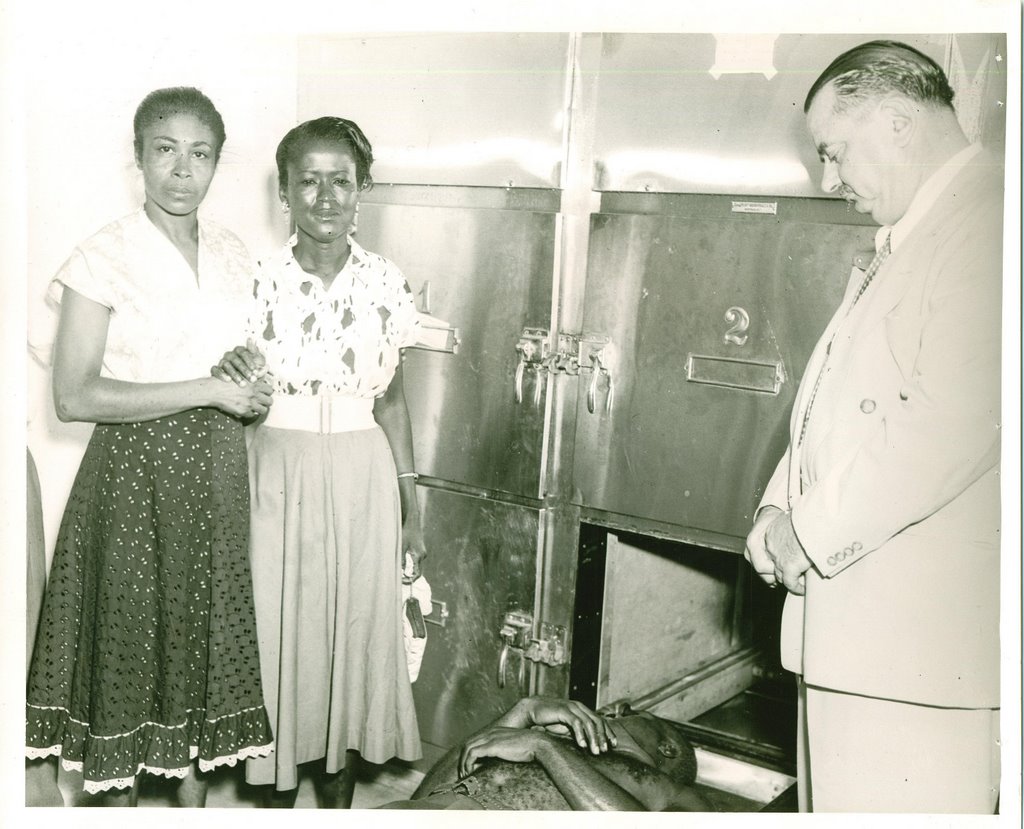
"Legal identification" of the victim is an element of the crime of murder. It must be proven at trial just as the other elements, e.g. premeditation do, but it is the most technical of those elements. It is almost never contested, and its proof is only a formality.

This is how legal id was done in the 1950's. A friend or family member would go to the the morgue. The Coroner would pull out the metal tray with the body and a photographer would memorialize the moment. Now, a less emotionally difficult procedure is used. The body is cleaned and a face-only photograph is shown. The relative views the photograph and signs the back.

The pathos of the in-person procedure is vivid in this picture. Look at the contrast in the faces of the two women. The woman on the right is Grief, the woman on the left, Strength. Look at them together in close-up. The strong woman has taken the other's hand in hers. The grieving woman holds a tissue in her left hand.

The grieving woman stands but only with the support of the other woman. Her shoulders are slightly slumped, her cheeks have the sheen of shed tears, her eyes still seep. She holds a tissue in her left hand. She is overwhelmed, broken, resigned.

The face of the woman on the left is steely resolve, personal pride, strength, almost defiance. She will not be broken by this murder. She is physical and emotional support for the other woman. Her build is bigger and stronger, her posture more erect. She will not be broken by anything.

The coroner stands in a respectful posture. Head bowed and hands clasped in front he could be in church praying if his eyes were closed.

The purpose of this photograph was legal and technical but a transcendent depiction of the human soul was the result. This is Public Occurrences.

Murder Case Photographs: #4 (Close-Up)

Murder Case Photographs: #4 (Close-up)

Tuesday, August 01, 2006

Tony Blair's Speech in Los Angeles

Tony Blair's Speech in Los Angeles

British Prime Minister Blair was clear in defining the dichotomy that exists in the world today. It is between Western (or more accurately Anglo-American and Judeo-Christian) values and Islam's hatred. In CNN's report on the speech Blair stated that the conflict de jour in the Middle East is no less than "part of the wider struggle for the soul of the region."

We must, he said, "recognize this struggle for what it truly is." It is whether "our values can beat theirs." That "would be at least along the first steps of the path to winning it." This is the language that is necessary to match the reality on the ground. Islam aims to destroy our culture and way of life. It is a struggle we must fight, and that we must and will win.

Blair is correct also in his "fear" that "a vast part of Western opinion is not remotely near this yet." For five years those of us who have seen this struggle for what it is have been exasperated at the learning curve of governmental and opinion leaders especially of President Bush's immediate declaration after 9/11 that "the war is not with Islam." You don't hear insouciant remarks like that as frequently now. Indeed you hear more what has been said in little blogs like this and from those, inter alia, like Daniel Pipes, those with more gravitas, that if the war isn't with Islam it is with a a critical mass of dedicated soldiers of Islam, bent on our utter destruction and backed by a strong minority of Muslim men-on-the-street and governments such as Iran, Syria, Pakistan and Saudi Arabia.

Prime Minister Blair states clearly what must be done: "it's about modernization within Islam and out of it."

Blair also unequivocally put his country's hand in with that of Israel: "Absent from so much of the coverage is any understanding of the Israeli predicament," he said. It is a struggle between the allied powers of Britain, America and Israel--not ridiculously against Terrorism, a fictional straw man--and Islam. Gone in Prime Minister Blair's speech is the confluence of this Islamic war, with the I.R.A., Basque separatists, Cheychyn rebels, and every other rag-tag bunch of guys with mortars. The struggle today is between Israel/America/Britain and Islam. Blair called out Syria and Iran for "their support of terrorism, their deliberate export of instability." "If they keep raising the stakes, they will find that they have miscalculated. "

"We need to make it clear to Syria and Iran that there is a choice: Come into the international community and play by the same rules as the rest of us or be confronted."

The words highlighted above are changes in the rhetoric of leaders like Blair and our own courageous President Bush. Changes in rhetoric matter at this level of discourse with speakers of this gravitas. More than any speech since 9/11 Prime Minister Blair's speech has starkly cast the choice for Islam and the West.

It is the most important speech of our time. This is Public Occurrences.

Sunday, July 30, 2006

Murder Case Photographs: #3


Murder Case Photographs: #3

1959.

Where's the dead guy? OOOhhh, that smart detective points us the right way. Otherwise we'd never have known, right? Pretty tough. Three guys standing, on their own feet too, as if their hearts are still beating and their synapses synapsing and one guy on the bed not looking so perky.

"Hey George, point at the body just so there's no doubt."???????

George, or whatever his name was, looks pissed too. "No I'm not the dead guy you moe-ron, HE (pointing) is!"

And what about George in profile. George, go to the gym much?

The guy behind George looks like he's going to cry or be sick.

And what about Shades? Looking right into the camera. Not pointing, not looking at the body. Maybe that's why George's pissed. Shades wanted to be the focus of the picture. Hey doofus, it's at night! You're indoors, take them OFF!

-Benjamin Harris

Friday, July 28, 2006

Murder Case Photographs: #2

Murder Case Photographs: #2


1955.

Black and white, dark and light, violence and safety. All the usual dichotomy suspects are present here.

Non-color photos are more mysterious because they're not quite how we really see things--that is, in color--so black and white photographs veil their subjects a little, there's a little burlesque in revealing almost all but leaving something to the imagination. They create or enhance a mood.

Here the archaic flash equipment exaggerates the contrasts, bleaching out the car and darkening even more the night background.

Mystery also in where this is. No signs or buildings to provide even a hint. An unpaved gravel road, quickly disappearing into the darkness around a curve.

In our nightmares this is what a murder scene looks like.


-Benjamin Harris

Thursday, July 27, 2006

Murder Case Photographs: #1


Murder Case Photographs: #1
1957

A few years ago the state Supreme Court ordered that a shift worn by a rape victim and introduced into evidence at the 1967 trial be found, if it could, so that DNA testing could be done. The case irked (almost half of) the Court which split down the middle. Four of the nine justices joined in an exasperated dissent.

The court's order went to the prosecutor's office where the trial was held and, randomly within that office, the irksome task devolved to me.

I went over to the office of the Clerk of court where the garment, if it existed, would be. I and the single deputy clerk who had been assigned the task in his office that I had been in mine spent...I don't know how long, but a long time looking for the dress. We eventually were able to determine that it had been destroyed years ago in a purging of non-capital case evidence that was taking up space in the clerk's office.

Along the way I discovered a part of the history of this magnificent city that I love so much, a city that was made infamous then glamorous by crime, patchily captured in the oldest remaining photographs of 1950's murder cases. I have tried murder cases all of my career, first as a prosecutor, now as a defense attorney. It is fitting that this be done.

The photographic evidence presented and preserved here was destined for the incinerator, just as the evidence from earlier decades--going back to the 1920's I was told--was destroyed years ago by the Clerk's office. Every month, to this day, the deputy district attorney's in the office got a blanket email from the clerk's office advising that evidence from the cases listed will be destroyed unless someone wants them.

I wanted them and so got hundreds of manilla envelopes containing evidence, almost all documentary, most photographic, from murder trials held in the 1950's. It was from one of these envelopes that I discovered the O'Malley Christmas day triple murder of 1956, the saddest case that ever was, last published here on December 13, 2004.

With this post I finally begin to publish the photographs. Some of them. You will see little blood and gore here. You will see this city as it was in a time that no longer exists and which few even remember. You will also see those photographs that moved me personally in some way, by their poignancy, their (unintended) artistry, even their (unintended) humor.

The first of these photographs above is a 1957 mugshot of a young, handsome murder suspect with period hair style and tropical shirt. Maybe a tourist. The photograph can be enlarged.

Part of the allure of these evidence folders is trying to piece together the whole from a very small part. You know only as much about the case as the physical evidence tells. I don't know anything about this case--or the suspect's "past" as we say (his prior criminal record if any)--but he looks...innocent, not in the legal sense, but in the sense of being callow.

Monday, July 24, 2006

Cesare Paciotti Jewels

Cesar Paciotti Jewels

"Jewels" = jewelry. We have brought this brilliant designer's women's shoes to readers attention previously.* Although not easy to find the shoes can be bought in the U.S. and on ebay. The jewelry line is unavailable in the U.S. however, and we tried.

Last night we found an Italian site from which Americans can purchase the jewelry. WWW.Boschi-gioielli.it sells a wide range of pieces that we presume is the entire line presently: rings, necklaces, pendants, earrings, cuff links ("wrist twists"), even key holders. They give Paciotti's design genius a new expressive outlet. On the shoes the House's signature stiletto logo is a mysterious, dangerous accessory that clashes with the soft sensuousness of the female-foot-in-high-heels form to produce thrillingly dissonant eye appeal.

In the jewelry medium the stiletto can be isolated. The psychological effect is different and just as breathtaking. We ordered a pair of cufflinks and a pair of earrings. Of course the stilettoworks as a logo on a man but it's not macabre or scary. This is not a pair of six-shooters. The stiletto is inspired design because its sleek lines are artistry. The look presented is unmistakable: this is design excellence that you are wearing not a weapon. It is beautiful and singular on a woman as a pair of earrings and it is bold and exciting without being threatening on a man as cufflinks.

Almost all of the Paciotti jewels on Bosch-gioielli are made in fine silver. Only one item comes in gold as an alternate. With shipping included the total for both the earrings and the cufflinks was 90 Euros, or about $114. On July 20 Paciotti announced that Bruce Willis would be the male face in their forthcoming American advertising campaign. This may be one of the last times that the jewelry of this remarkable designer is available at so little cost.


*June 2, 2006.


-Benjamin Harris

Saturday, July 22, 2006

Village WordSmithy


Village WordSmithy

"a cigarette-cured voice."

Brilliant, brilliant and absolutely exquisite.

Margaret Talbot on Orianna Fallaci in the July 24, 2006 The New Yorker. If Ms. Talbot never wrote another word her literary fate should be secured by that luscious turn of phrase.


Tuesday, July 18, 2006

Iraq: "U.N.: 14,000 Iraqis killed in 2006"

Iraq: "U.N.: 14,000 Iraqis killed in 2006"

That is CNN's headline. The initial assumption obviously was that these were deaths of coalition troops, insurgency combatents and civilians caught in the cross fire.

That does not appear to be true. CNN's article is confusing, at least to us. CNN states that the U.N. document "includes...casualty figures and...anecdotes from the insurgent and sectarian warfare..." That is CNN speaking, not the U.N. The reasonable reading is that the 14,000 figure includes war deaths in the sense used in the first paragraph of this post.

However even those words suggest that the figures are more than war deaths. "Includes" means there's something else. One of CNN's subheads, "Armed robbers hit Baghdad bank," suggests that street crime is "included." Therefore the initial assumption above is incorrect. The 14,000 figure includes both war and street crime killings. The second assumption is that of course war-related deaths dominate the street crime number.

However, that does not appear to be true either. The overall tone of the rest of the article is that street crime dominates. For example CNN refers to the U.N. finding that homosexuals are being killed for their sexual orientation as are those who do not conform to dress and hair rules. Who is doing this, the CNN report is confusing on: "Militias and 'death squads,' " are the U.N.'s words on the targeting of gays. Which "militias and 'death squads,' " the insurgents who are fighting the coalition or something more akin to street gangs?

This is an important point to be clear on. The greater the percentage of the 14,000 that comes from street crime, the more fighting it would be "normal" city crime tactics: firearms restrictions, swift arrest and punishment, etc. The predicate for that kind of action is a strong government. The greater the percentage coming from street crime would logically mean a reduced role for coalition troops.

The greater the percentage of the 14,000 coming from the war the more to the argument that the Administration has botched the war.

The tone of the entire article seems to be that something like street crime is the larger component of the two.

-These are CNN's words: "Kidnappings have been part of the...Iraqi scene since the insurgency began." It's not clear if it's the insurgents who are doing it or street criminals. CNN's next sentence however is that the kidnappers "are not only motivated by sectarianism or politics; organized crime appears to be involved..."

-These are the U.N.'s words: "The police captured members of this gang..." who had been kidnapping, raping and killing children of both genders.

-U.N.: "Civilian casualties resulted mainly from bombings and drive-by shootings," from among other sources, "armed clashes with the police and the security forces."

Maybe follow-up reporting by the media will clarify this issue, which is important for how the U.S. proceeds from here.

-Benjamin Harris

Sunday, July 16, 2006

"What a Wonderful World" Department*

"What a Wonderful World" Department

Smirnoff Green Apple Vodka.

*see also May 23, 2004

-Benjamin Harris

Saturday, July 15, 2006

AirBust

AirBust

The most recent symbol of Old Europe's inability to compete in the 21st century economy is the announcement that AirBus will not be able to meet the delivery deadline on its new model jet. One airline has cancelled its contract altogether and even the delays to those who haven't will cost EADS "billions" according to news reports.

EADS is the ambitious multi-national European consortium formed in 1970 to put Europe in competition with and to beat U.S. companies in the lucrative and prestigious jet building industry. EADS inception was propitious. Weakened by fierce competition among themselves, Boeing, Lockheed, and McDonnell-Douglas were vulnerable to a new well-capitalized player and AirBus was that, and government subsidized in addition.

And AirBus did compete. Odds are anyone in the U.S. who has flown even once or twice in the last year has flown on an AirBus jet. And poised for victory AirBus was. Boeing shook out as the American manufacturer from the earlier competition and AirBus has Boeing wounded and bleeding.

In this competition, as in so many others, there is one pivotal moment, the metaphorical fork in the road. A year or two ago both manufacturers at the same time faced the end of their current models lifespan and had to plan for the next generation and each chose a completely different vision of the future of air travel. Boeing's corporate life depends on selling its vision to the air industry.

Boeing chose to work within the current hub-and-spoke paradigm and to build a fleet of faster, more agile, cheaper and more fuel efficient jets. AirBus boldly bet against the paradigm and predicted the (lucrative anyway) future lay in long-haul travel. It therefore planned a fleet of super-huge jets, much larger than the 747, double-decker behemoths with immense passenger capacity designed to traverse intercontinental distances, and the longer the better such as Asia to America.

AirBus' vision was bold, but risky. Its jets were expensive to build and not as fuel-efficient and therefore expensive to operate. Who wants to bet on lower or even stable oil prices over the next generation? Also its planes were so big that expensive changes would have to be made to world airports. Runways would have to be reinforced against the added weight of the jets. Gates would have to be modified to accommodate the height of the new jets passenger doorway. And the last pan-European air travel Grand Vision, the Concorde, had literally and figuratively crashed and burned in France.

AirBus had buyers into its vision however and the showdown with Boeing moved from the drawing board to the assembly plant. But the one thing that any highly competitive industry cannot have is delays. Time is money and delays cost money. Corporate plans go out the window, Plan B's have to be gone to, and trust is compromised. If you're going to buy into a corporation's vision you have to trust.

Additionally, AirBus' delays were caused by a problem ancient to Old Europe and one it cannot shake to this day. EADS charter requires that one of the company's two chief positions go to a Frenchman and the other to a German. Groan. And the present debacle was created because the Frenchman and the German are at each other's throats. Double groan. As Dave Barry would say, I am not making this up.

The delivery delay is not fatal to AirBus but it could be the moment when it all began to fall apart. All Boeing might have to do is obey the lawyer's adage, "don't interrupt your opponent when he is making a fool of himself."

-Benjamin Harris

Friday, July 14, 2006

Sports: Soccernet

Sports: Soccernet

The best website for followers of European soccer.

Monday, July 03, 2006

Politics: Lieberman May Run as Independent

Politics: Lieberman May Run as Independent

Senator Joseph Lieberman announced just a few minutes ago that he will run for re-election as an independent in the fall should he lose the Democratic primary.

Liberal businessman Ned Lamont is challenging Lieberman. Mr. Lamont has got the money and Sen. Lieberman has got the enemies to create this situation. Lieberman is a Hawk on foreign policy, he supports the war in Iraq. He was even rumored to be on President Bush's short list for Secretary of Defense if Donald Rumsfeld were replaced. He is labeled the President's "favorite Democrat."

That's too much for the so-called "Democratic Wing" of the Democratic party. The Daily Kos and MoveOn, two Democratic Wing internet water coolers have rallied opposition to Lieberman. The Daily Kos has predicted bluntly that "Lieberman's going to lose."

That a veteran, well-respected, centrist, incumbent, who was the party's vice-presidential candidate six years ago would be in jeopardy of losing his party's nomination is testament to the Groundhog Day-like consistency of so much Democratic behavior since 1968.

And so we take down from our bookshelf a worn edition of Cliches to try to find the rhetorical equivalent to this behavior and turn to the index and find Politics and then the sub-heading Democrats and we find a fitting entry: "firing squad; Democrats organize in circle." And in a cliche frame of mind we issue a prediction McLaughlin Group-like: Lieberman will win in November regardless, and the Democratic party will be further marginalized. This is Public Occurrences.

Sunday, July 02, 2006

Photographs of Beijing's Hutongs-The Children


Photographs of Beijing's Hutongs-The Children

I have come up with a solution to China's population problem, I WILL ADOPT ALL OF THE CHILDREN! We were utterly charmed by them all. These two little angels and the one below were our biggest heartthrobs. These two are twins (Duh). Chinese couples get around the one-child-only law by going a few months without being able to conceive and then going to a friendly M.D. who will give them fertility drugs, thus increasing the chances of multiple births. Far as I could tell that was a very good thing. Look how innocently and demurely these two little babies stand here.

We were going to an art museum this weekend day and happened onto a children's art class. You can see the other little ones in the background of this photograph. I saw these two cherubs and tried to take their picture among their classmates but they ran off squealing with embarrassment. It didn't take too much coaxing to get them to stop a minute and pose and this timeless depiction of childhood innocence and beauty was the result.