
Thursday, May 28, 2015
A Officer's Life for Me! CONTACT: "Savages."
September 11:
Dear Papa [aka "governor."],
...[W]e marched 3 miles...to a hill surrounded by forests...Here we encamped--I of course, after having had no sleep for two or three nights & being on my feet all day [Take off your heels and put on Aunt Elizabeth's slippers.], was put on guard 2 days after being on guard before, without guard tents or any thing else. Or any thing else. Where's the iron bedstead from Clapp, Fulls & Brown?
Our present camp is on high ground with a view of Washington. We came to it through what seemed immense forests. At every half mile's interval, crowds of half clad savages who called themselves Pennsylvania & New York troops came running down.
Screw Henry Abbott and the horse he rode in on. He wouldn't have made it as far as the Wilderness before getting whacked, I'd a done it with my bare hands right there outside Washington. Hey! You know what? I'm switching sides, I'm deserting...Somebody teach me how to talk southern...I'm rooting for the South now! Y'all. I've got more in common with those half clad savages from Pennsylvania than I do with this half-man king of the punk-asses. I want a best out of three on the Civil War! Allahu Akbar to the Johnny Reb who was the lucky shot.
Immensely big fellows, good natured, friendly, & unsophisticated; that is to say, without the slightest notion of military etiquette or discipline.
NOTE: He has been an officer two months, trained in "military etiquette and discipline" for TWO MONTHS.
Privates would come up & without so much as saluting, ask us officers questions as if they were actually thirsty to know something of the outer world.
Dear Papa [aka "governor."],
...[W]e marched 3 miles...to a hill surrounded by forests...Here we encamped--I of course, after having had no sleep for two or three nights & being on my feet all day [Take off your heels and put on Aunt Elizabeth's slippers.], was put on guard 2 days after being on guard before, without guard tents or any thing else. Or any thing else. Where's the iron bedstead from Clapp, Fulls & Brown?
Our present camp is on high ground with a view of Washington. We came to it through what seemed immense forests. At every half mile's interval, crowds of half clad savages who called themselves Pennsylvania & New York troops came running down.
Screw Henry Abbott and the horse he rode in on. He wouldn't have made it as far as the Wilderness before getting whacked, I'd a done it with my bare hands right there outside Washington. Hey! You know what? I'm switching sides, I'm deserting...Somebody teach me how to talk southern...I'm rooting for the South now! Y'all. I've got more in common with those half clad savages from Pennsylvania than I do with this half-man king of the punk-asses. I want a best out of three on the Civil War! Allahu Akbar to the Johnny Reb who was the lucky shot.
Immensely big fellows, good natured, friendly, & unsophisticated; that is to say, without the slightest notion of military etiquette or discipline.
NOTE: He has been an officer two months, trained in "military etiquette and discipline" for TWO MONTHS.
Privates would come up & without so much as saluting, ask us officers questions as if they were actually thirsty to know something of the outer world.
Have 'em shot for disrespecting an officer, Henrietta. "As if:" They were "half clad savages," not fully human so they asked questions about the "outer world" as if they "actually" wanted to know. The common soldiers in the United State army, especially the volunteers, were treated by Abbott and Humphreys and that "type" as good for nothing except for use as cannon fodder. They were not quite human. Disposable.
When they found we were from Boston, they universally manifested the greatest delight & enthusiasm. They all said, "I know you came from Bostonyou're all fairies and dandies and your anus is so elastic it makes a flapping sound in the wind as you walk, your clothes are so good & you've got rifles."
You have no idea of the admiration there is for Massachusetts men out in these ragged...regiments; it is gratifying to one's pride, you can imagine. You can imagine.
As we came along, though we came right out from amongst them, they asked where we were from & where bound, with as much ignorance as if we were foreigners suddenly coming in to strange country.
When they found we were from Boston, they universally manifested the greatest delight & enthusiasm. They all said, "I know you came from Boston
You have no idea of the admiration there is for Massachusetts men out in these ragged...regiments; it is gratifying to one's pride, you can imagine. You can imagine.
As we came along, though we came right out from amongst them, they asked where we were from & where bound, with as much ignorance as if we were foreigners suddenly coming in to strange country.

An Officer and a Gentleman.
September 7:
Dear Mamma,
...I shall soon write to the governor [pet name for Papa], the next letter to Carry & the next to Sally. Sam I suppose won't want one, as he couldn't come to bid me good bye when I went off. [That's because you tried to take his sword you selfish prick.]
...
We are all rather seedy as the colonel, with his usual shrewdness, has managed to have the cars go 3 miles an hour in the day, so as to keep the men in the car overnight; decidedly the most convenient way of disposing of the men, but rather rough on the officers who get very little sleep or to eat.
Where were they going, Auschwitz? That is the most reasonable reading of "disposing of" in context. That didn't happen and he must not mean that. He must mean it was the most convenient means of "controlling," or "keeping tabs on" the men, to prevent them from wandering off, deserting. "The men," however, are disposable. We "officers" are not, we deserve better treatment.
Give my love to all the family, my lady friends, Miss Jackson, Miss Sargent,...&c.
&c.
Dear Mamma,
...I shall soon write to the governor [pet name for Papa], the next letter to Carry & the next to Sally. Sam I suppose won't want one, as he couldn't come to bid me good bye when I went off. [That's because you tried to take his sword you selfish prick.]
...
We are all rather seedy as the colonel, with his usual shrewdness, has managed to have the cars go 3 miles an hour in the day, so as to keep the men in the car overnight; decidedly the most convenient way of disposing of the men, but rather rough on the officers who get very little sleep or to eat.
Where were they going, Auschwitz? That is the most reasonable reading of "disposing of" in context. That didn't happen and he must not mean that. He must mean it was the most convenient means of "controlling," or "keeping tabs on" the men, to prevent them from wandering off, deserting. "The men," however, are disposable. We "officers" are not, we deserve better treatment.
Give my love to all the family, my lady friends, Miss Jackson, Miss Sargent,...&c.
&c.
An Officer's Life for Me!
September 1, 1861:
Dear Aunt Elizabeth,
I am very much obliged to you indeed for your slippers.
Dear Aunt Elizabeth,
I am very much obliged to you indeed for your slippers.
An Officer's Life for Me!
August 13 or 14, 1861:
The colonel, major & one of our Nantucket privates captured yesterday 1 sergeant & 15 privates who had been lured away [by] the tempting offers of the New York Irish [Brigade], as well as the New York recruiting sergeant who [lured] them off, the latter being safely lodged in jail to be tried by civil process...We are going to shoot the deserting sergeant if we can.

Please come out & see a dress parade whenever you get a chance.

Nothing prepares us non-soldiers for the bolded sentence. How were the sergeant and privates "deserting?" They weren't going back to the plow and they weren't going over to the enemy, they were staying in the United States army, they just got a better offer, it seems. There were very few deserters executed in the Civil War, especially early on. The more reasonable reading of this paragraph therefore is that it shows Abbott's bloodlust. "Please come out & see a dress parade..." following immediately after "We are going to shoot the deserting sergeant..." shows his detachment. It reads like Humphreys' letter to his wife after Fredericksburg, "We lost 1,000 men," Period. "Oh, it was glorious."
The colonel, major & one of our Nantucket privates captured yesterday 1 sergeant & 15 privates who had been lured away [by] the tempting offers of the New York Irish [Brigade], as well as the New York recruiting sergeant who [lured] them off, the latter being safely lodged in jail to be tried by civil process...We are going to shoot the deserting sergeant if we can.

Please come out & see a dress parade whenever you get a chance.

Nothing prepares us non-soldiers for the bolded sentence. How were the sergeant and privates "deserting?" They weren't going back to the plow and they weren't going over to the enemy, they were staying in the United States army, they just got a better offer, it seems. There were very few deserters executed in the Civil War, especially early on. The more reasonable reading of this paragraph therefore is that it shows Abbott's bloodlust. "Please come out & see a dress parade..." following immediately after "We are going to shoot the deserting sergeant..." shows his detachment. It reads like Humphreys' letter to his wife after Fredericksburg, "We lost 1,000 men," Period. "Oh, it was glorious."
Wednesday, May 27, 2015
A Soldier's Life for Me! Shoes, Iron Bedstead, Silk Hankerchiefs!
...2 pair of army shoes [Pumps or sandals? And how high a heel?] at Rice [Oh, I love him.] who has my measure...and an iron bedstead from Clapp, Fulls & Brown [Sooo much more sophisticated than Bed Bath & Beyond]...a couple of silk handkerchiefs wouldn't go bad...[Are you kidding me, not at all! De riguer!]
You done? Okay, Henry, this is what I want you to do. Tonight after your momma and papa have fallen asleep I want you to put on your new very fine flannel uniform, your sash, your new shoes, and I want you to quietly crawl into your new iron bedstead and lay down on your back, bend wayyy over backwards and jerk off all over your face.
You done? Okay, Henry, this is what I want you to do. Tonight after your momma and papa have fallen asleep I want you to put on your new very fine flannel uniform, your sash, your new shoes, and I want you to quietly crawl into your new iron bedstead and lay down on your back, bend wayyy over backwards and jerk off all over your face.
A Soldiers's Life for Me! Flannel, Very Fine Flannel.
August 26(?):
Dear Papa,
...[I]f you would be kind enough...have the [errand] boy [The "errand boy!"] go &...take my...uniform to Snell...on Tremont St...tell him to build me a suit of flannel...of very fine flannel [Of very "fine flannel!" Omg]...to be done & sent by an express [Hello-o-o FedEx.] that will carry it promptly by Friday. ["Promptly by Friday!"] Also get me...
Enough.
Dear Papa,
...[I]f you would be kind enough...have the [errand] boy [The "errand boy!"] go &...take my...uniform to Snell...on Tremont St...tell him to build me a suit of flannel...of very fine flannel [Of very "fine flannel!" Omg]...to be done & sent by an express [Hello-o-o FedEx.] that will carry it promptly by Friday. ["Promptly by Friday!"] Also get me...
Enough.
A Soldier's Life for Me! More $
August 13 or 14:
Dear Papa,
I have got to trouble you again for some money.
Dear Papa,
I have got to trouble you again for some money.
A Soldier's Life for Me! Pistol with Pretty Case, $$.
August 8:
Dear Papa,
I have just got the pistol. I am extremely obliged to you for it. The case that comes with it is very pretty [PAUSE; throw the book; curse his existence; pick up the book; return to seat; UNPAUSE] & what is of more importance very convenient indeed. [Yes, that is more important.]...it is just the thing...just what every man wants.[PAUSE: Keep calm and carry on. UNPAUSE]
I suppose [Shrine] & Brown have sent in the bill for sword & sash. I might have got each [for] $2* cheaper, but the articles for that price were of a very much inferior quality...There was also a sword suspending strap that I bought at the same place of $.75.**
*$1 in 1861 worth $27 today so he could have gotten both for $54 less combined.
**$20.25.
Dear Papa,
I have just got the pistol. I am extremely obliged to you for it. The case that comes with it is very pretty [PAUSE; throw the book; curse his existence; pick up the book; return to seat; UNPAUSE] & what is of more importance very convenient indeed. [Yes, that is more important.]...it is just the thing...just what every man wants.[PAUSE: Keep calm and carry on. UNPAUSE]
I suppose [Shrine] & Brown have sent in the bill for sword & sash. I might have got each [for] $2* cheaper, but the articles for that price were of a very much inferior quality...There was also a sword suspending strap that I bought at the same place of $.75.**
*$1 in 1861 worth $27 today so he could have gotten both for $54 less combined.
**$20.25.
A Soldier's Life for Me! $.
August 7:
Dear Papa,
I am much obliged to you for [the money for] the sword and sash.
Dear Papa,
I am much obliged to you for [the money for] the sword and sash.
A Soldier's Life for Me! Dress Parade, Pistol.
We are to wear swords hereafter at dress parades. Dress parades. Now Sam [brother, 15 y.o.] has got a sword that Fletch gave him & so he won't need any sword...why could't you ask him to send me his sword...
As for the sash, [As for the sash, Henry, take the sash, wrap it up tight in a little ball, okay? And then stick it up your ass.], I believe the class [Harvard 1860] give sashes, though I am afraid every body is out of town & I shan't hear any thing about it. However I can wait for that. [That's a load off.] I made inquiries about buying out an officer, & I don't believe it can be done.
You said you were going to give me a pistol before I went, you know...[ellipses in ORIGINAL]
As for the sash, [As for the sash, Henry, take the sash, wrap it up tight in a little ball, okay? And then stick it up your ass.], I believe the class [Harvard 1860] give sashes, though I am afraid every body is out of town & I shan't hear any thing about it. However I can wait for that. [That's a load off.] I made inquiries about buying out an officer, & I don't believe it can be done.
You said you were going to give me a pistol before I went, you know...[ellipses in ORIGINAL]
An Officer's Life for Me! Sword & Sash.
July 27:
Dear Papa,
I was obliged to come in town this morning...I wanted to see you about getting a sword & sash.

Dear Papa,
I was obliged to come in town this morning...I wanted to see you about getting a sword & sash.

Why do Abbott and Humphreys, that "type," Holmes' word, get under my skin so much?
Third letter, May 1861:
Third letter, May 1861:
Dear Papa,
Have you had time to see any thing about that commission...? Tom Robeson has got [one]...But I suppose that all the other commissions are taken & HE GOT HIS THROUGH STRONG FAMILY INFLUENCE. (emphasis added) Unlike me, whose family has no strong influence, evidently. Boo-hoo-hoo.
I don't know any thing about the expense of a commission but...I certainly shouldn't wish to trouble you...
Oh gag me with a spoon, the spoiled, manipulative brat.
Fourth letter, July 11:
Dear Mamma,
I write to tell you that I have accepted the offer of a commission I ["I!" That ungrateful little snot!] have got me. I had made up my mind to get a commission a month ago [We KNOW!]
They get under my skin so much because the war was not real to them. It was not war to them, it was an "extremely pleasant" adventure so far for Abbott--dress parades! ladies! Oh, it was just bully. For both becoming a soldier was an "opportunity" to prove their manhood. Getting a commission for Abbott, getting his own regiment for Humphreys, was like getting into Harvard, it was what an Abbott and a Humphreys must do! It was what an Abbott and a Humphreys were entitled to--to lead, to command. It was getting that job you always wanted:
It is nothing more serious than going into trade or a profession.
No, Little Abbott, it is "more serious" than that. In this trade, this profession, you are going to be killing people you little shit, you are not going to be reading law with Papa, you are going to be killing people, you are going to be getting other people killed under your command, you are going to get killed.
It is singular that both of these men acted identically, like "maniacs," in the same battle, Fredericksburg.
It is singular that both of these men acted identically, like "maniacs," in the same battle, Fredericksburg.
Life, their own and others, did not matter to this "type." That's why they get under my skin so much.
Tuesday, May 26, 2015
Mr. Scott says Mr. Abbott was a fine writer. He was not as fine a writer as is Mr. Scott but I remembered something when I read that. A few years ago I email corresponded with another descendant, a Washington lawyer, of a soldier in the Pennsylvania 133rd. I expressed frustration at the lack of writing from the regiment and he, I have forgotten his name, emailed me back that he bet our great-granddaddies didn't even know how to write, they were farmers.
History is written by the literate.
History is written by the literate.
The Short Happy Life of Henry L. Abbott.
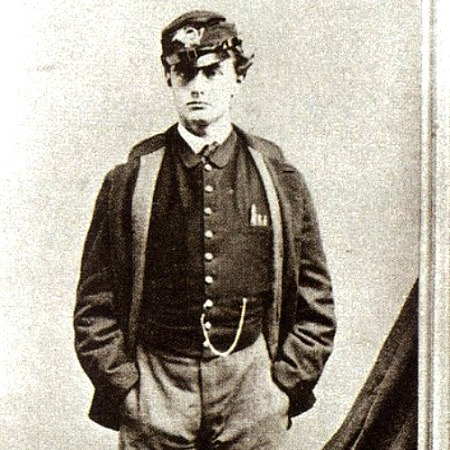
Was it real pleasant?
I got this book. I have never liked Henry Livermore Abbott, don't like his swinging his sword on his finger, don't like the things he wrote that I have read, don't even like his looks. So I got this book of his letters, Fallen Leaves. I really like the editor, Robert Garth Scott; he is a marvelous writer. Scott does like Abbott and maybe I will come to also.
Holmes and Abbott were buddies (I don't like Holmes.). In his 1884 Memorial Day address, Holmes asked his audience of Civil War veterans "Was it just community pressure that caused us to enlist?" To which I answered (unasked), "I think so," and in the next sentence Holmes answered, "I think not." Well, I think Holmes' pants were on fire in that answer, that's what I think. Abbott, despite being an admitted chicken, admits that is why he enlisted.
I have also gotten the impression repeatedly that for many young men enlisting in the Civil War was about proving their manhood. Did they have "the right stuff?" Or were they poofs? Especially privileged, aristocratic Harvards, like Abbott and Holmes. For them, at least at first, it was: "It's not a job. It's an adventure." I don't like that. First letter:
Dear Papa,
We are having an extremely pleasant time down here...the work is just hard enough to give you a rousing appetite...
Could you get me a commission? If I could be in Ned and Fletch's (brothers) division "it would really be bully." It would really be bully. "& I wish you would let ["mamma" send me] a bottle of Lacryna Crystina" (a wine). It would really be bully.
Second letter:
Dear Papa,
...I am very much grieved...that you should have such a very small opinion of me as you intimate in your letter, that I should be contented with PLAYING SOLDIER down here...I am really hurt that you should think me a MERE TRIFLER. (Emphassis ADDED)
Why on earth should papa ever think that?
My tastes are not warlike like Ned and Fletcher's, but literary & domestic...I don't think I should ever have tried [soldiering] untill [sic] there was an actual necessity for every able bodied (sic!) man, if it hadn't been for Ned and Fletch enlisting.
HELD: Holmes' pants were on fire.
Holmes and Abbott were buddies (I don't like Holmes.). In his 1884 Memorial Day address, Holmes asked his audience of Civil War veterans "Was it just community pressure that caused us to enlist?" To which I answered (unasked), "I think so," and in the next sentence Holmes answered, "I think not." Well, I think Holmes' pants were on fire in that answer, that's what I think. Abbott, despite being an admitted chicken, admits that is why he enlisted.
I have also gotten the impression repeatedly that for many young men enlisting in the Civil War was about proving their manhood. Did they have "the right stuff?" Or were they poofs? Especially privileged, aristocratic Harvards, like Abbott and Holmes. For them, at least at first, it was: "It's not a job. It's an adventure." I don't like that. First letter:
Dear Papa,
We are having an extremely pleasant time down here...the work is just hard enough to give you a rousing appetite...
Could you get me a commission? If I could be in Ned and Fletch's (brothers) division "it would really be bully." It would really be bully. "& I wish you would let ["mamma" send me] a bottle of Lacryna Crystina" (a wine). It would really be bully.
Second letter:
Dear Papa,
...I am very much grieved...that you should have such a very small opinion of me as you intimate in your letter, that I should be contented with PLAYING SOLDIER down here...I am really hurt that you should think me a MERE TRIFLER. (Emphassis ADDED)
Why on earth should papa ever think that?
My tastes are not warlike like Ned and Fletcher's, but literary & domestic...I don't think I should ever have tried [soldiering] untill [sic] there was an actual necessity for every able bodied (sic!) man, if it hadn't been for Ned and Fletch enlisting.
HELD: Holmes' pants were on fire.
Monday, May 25, 2015
Thank you guys for reading "How real was it?" today. Seven pageviews on a new post in under 12 hours is a lot for Publocc. I spent so much time at my desk writing that thing on Friday I hurt my damn back! Took so many Advil Saturday I couldn't write anything. Finished it up with a couple of hours Sunday morning. Didn't proof it, too sore and tired.
I wrote "How real was it?" with no other sources than Holmes' 1884 and 1899 addresses. There is support in the literature for everything I wrote, however. I had the damnedest time finding the 1899 speech, it was in a book called The Fundamental Holmes. While looking for that speech I stumbled onto another book on Holmes with the word "Valueless" in the title. I used "value-free" in the post.
After after I posted "How real was it?" I lay down to ease my back and read and the book I picked off the shelf was Gordon Wood's The Idea of America. I didn't like that book when I read it a couple of years ago, I thought Professor Wood was a punkin' eater and I wrote a post back then on that. The American Revolution seemed to mystify him: The American colonists were free and happy and had good reasons to be happy, he wrote. So, why did they revolt? The rest of the book (To be accurate, the rest of it I read, because I got exasperated and didn't finish.) was an unconvincing attempt, so it seemed to me, to paint a little lipstick on the pig. You know how you sometimes get the feeling from the introduction that the author hadn't quite figured out what he wanted to say--it's overlong, it meanders? Well, that was the impression I got again from reading Professor Wood's introduction, so to stave off re-exasperation a little longer I skipped the rest of the introduction and just opened the book to a random chapter. The first sentence was this:
"Were the American Revolutionaries mentally disturbed?"
I had read that chapter before! I had marked it with a post-it note and underlined that sentence--but I had no memory of reading either sentence or chapter. I don't think I got that idea from the book, I think I got that idea from actually reading the Declaration of Independence! I think that idea was probably why I bought The Idea of America and in re-reading that chapter, "Conspiracy and the Paranoid Style: Causality and Deceit in the Eighteenth Century," (Even the length of Professor Wood's chapter headings exasperate me.) I reacquainted myself with Professor Wood's tortured, desperate attempts to answer that question, "No." So I didn't finish it again.
So, as I was saying...There is support within the serious literature for all the thoughts I spewed forth in "How real was it?," for all the thoughts I've spewed forth in the last couple of weeks on the Civil War, including the proposition that Andrew Atkinson Humphreys was mentally ill, for my more general, more flamboyant assertion that "America was born a lunatic with a forged birth certificate"--I say, there is support for it all, but I didn't know it.
I wrote "How real was it?" with no other sources than Holmes' 1884 and 1899 addresses. There is support in the literature for everything I wrote, however. I had the damnedest time finding the 1899 speech, it was in a book called The Fundamental Holmes. While looking for that speech I stumbled onto another book on Holmes with the word "Valueless" in the title. I used "value-free" in the post.
After after I posted "How real was it?" I lay down to ease my back and read and the book I picked off the shelf was Gordon Wood's The Idea of America. I didn't like that book when I read it a couple of years ago, I thought Professor Wood was a punkin' eater and I wrote a post back then on that. The American Revolution seemed to mystify him: The American colonists were free and happy and had good reasons to be happy, he wrote. So, why did they revolt? The rest of the book (To be accurate, the rest of it I read, because I got exasperated and didn't finish.) was an unconvincing attempt, so it seemed to me, to paint a little lipstick on the pig. You know how you sometimes get the feeling from the introduction that the author hadn't quite figured out what he wanted to say--it's overlong, it meanders? Well, that was the impression I got again from reading Professor Wood's introduction, so to stave off re-exasperation a little longer I skipped the rest of the introduction and just opened the book to a random chapter. The first sentence was this:
"Were the American Revolutionaries mentally disturbed?"
I had read that chapter before! I had marked it with a post-it note and underlined that sentence--but I had no memory of reading either sentence or chapter. I don't think I got that idea from the book, I think I got that idea from actually reading the Declaration of Independence! I think that idea was probably why I bought The Idea of America and in re-reading that chapter, "Conspiracy and the Paranoid Style: Causality and Deceit in the Eighteenth Century," (Even the length of Professor Wood's chapter headings exasperate me.) I reacquainted myself with Professor Wood's tortured, desperate attempts to answer that question, "No." So I didn't finish it again.
So, as I was saying...There is support within the serious literature for all the thoughts I spewed forth in "How real was it?," for all the thoughts I've spewed forth in the last couple of weeks on the Civil War, including the proposition that Andrew Atkinson Humphreys was mentally ill, for my more general, more flamboyant assertion that "America was born a lunatic with a forged birth certificate"--I say, there is support for it all, but I didn't know it.
In Memoriam.
Sgt. Nathan Bracken, 133rd Pennsylvania Volunteers Regiment, killed in action December 13, 1862, Fredericksburg, Virginia.
Lt. John W.K. Ranck, 10th Mountain Division, 5th U.S. Army, killed in action April 30, 1945, near Nago, Italy.
Lt. John W.K. Ranck, 10th Mountain Division, 5th U.S. Army, killed in action April 30, 1945, near Nago, Italy.
How real was it?
There's liar!-liar!-your-underpants-are-in-flames history and then there are Civil War remembrances. This is Holmes reality per the a la mode Romantic Civil War school. This is Holmes as Sir Walter Scott. There is another reality for Holmes.
The soldiers who were doing their best to kill one another felt less of personal hostility, I am very certain, than some who were not imperilled by their mutual endeavors. I have heard more than one of those who had been gallant and distinguished officers on the Confederate side say that they had had no such feeling. I know that I and those whom I knew best had not.
...
You could not stand up day after day in those indecisive contests where overwhelming victory was impossible because neither side would run as they ought when beaten, without getting at least something of the same brotherhood for the enemy that the north pole of a magnet has for the south--each working in an opposite sense to the other, but each unable to get along without the other. As it was then , it is now. The soldiers of the war...can join in commemorating a soldier's death with feelings not different in kind, whether he fell toward them or by their side.
I've read this sentiment so often I believe it. It is how Joshua Chamberlain expressed it also. I believe as Holmes says that many others in the Civil War felt likewise. It is certainly consistent with the sentimentality of the reunions.
This is very Chinese to me: "You can't have a struggle session without me (the victim) can you?" "Each unable to get along without the other." This is not real-real. This is the Civil War as a stage production, each actor playing his role. This is Fate. In this conception being a soldier in the Civil War was a job, a duty. There is a detachment of free will in that. Most of us don't want to go to work, we have to. Does Holmes take that commonly-expressed absence of free will further, i.e. does he believe also that it was the soldiers' "fate," their "destiny?" that they were in the hands of God?
The soldiers who were doing their best to kill one another felt less of personal hostility, I am very certain, than some who were not imperilled by their mutual endeavors. I have heard more than one of those who had been gallant and distinguished officers on the Confederate side say that they had had no such feeling. I know that I and those whom I knew best had not.
...
You could not stand up day after day in those indecisive contests where overwhelming victory was impossible because neither side would run as they ought when beaten, without getting at least something of the same brotherhood for the enemy that the north pole of a magnet has for the south--each working in an opposite sense to the other, but each unable to get along without the other. As it was then , it is now. The soldiers of the war...can join in commemorating a soldier's death with feelings not different in kind, whether he fell toward them or by their side.
I've read this sentiment so often I believe it. It is how Joshua Chamberlain expressed it also. I believe as Holmes says that many others in the Civil War felt likewise. It is certainly consistent with the sentimentality of the reunions.
This is very Chinese to me: "You can't have a struggle session without me (the victim) can you?" "Each unable to get along without the other." This is not real-real. This is the Civil War as a stage production, each actor playing his role. This is Fate. In this conception being a soldier in the Civil War was a job, a duty. There is a detachment of free will in that. Most of us don't want to go to work, we have to. Does Holmes take that commonly-expressed absence of free will further, i.e. does he believe also that it was the soldiers' "fate," their "destiny?" that they were in the hands of God?
We believed that it was most desirable that the North should win; we believed in the principle that the Union is indissoluable; we, or many of us at least, also believed that the conflict was inevitable, and that slavery had lasted long enough....we equally believed that those who stood against us held just as sacred conviction that were the opposite of ours,...we respected [the Confederates] as every men with a heart must respect those who give all for their belief.
...
There is one who on this day is always present on my mind...[I]n the streets of Fredericksburg...he
would become the focus of a hidden and annihilating fire...[He] was again moving on, in obedience
to superior command, to certain and useless death, when the order he was obeying was
countermanded... if you had seen him with his indifferent carriage, and sword swinging from his
finger like a cane, you would never have suspected that he was doing more than conducting a company drill on the camp parade ground.
Tons of unfeeling duty. Duty, duty, duty. (Humphreys was not the only one acting insanely at F-burg.)
...
There is one who on this day is always present on my mind...[I]n the streets of Fredericksburg...he
would become the focus of a hidden and annihilating fire...[He] was again moving on, in obedience
to superior command, to certain and useless death, when the order he was obeying was
countermanded... if you had seen him with his indifferent carriage, and sword swinging from his
finger like a cane, you would never have suspected that he was doing more than conducting a company drill on the camp parade ground.
Tons of unfeeling duty. Duty, duty, duty. (Humphreys was not the only one acting insanely at F-burg.)
Holmes swings between those opposite poles. Was it a job or a "sacred conviction?" How many folks in the pizza delivery profession hold a "sacred conviction" about their life's work and "give all for their belief?" To go about one's work with a sacred conviction is to willingly, enthusiastically participate in a higher cause. That sentiment is inconsistent with the earlier drudgery of going to work, of doing one's duty. In the first, there is free will in the choosing, in the latter, not so much. In the former, one can quickly lose free will, giving it over to the higher cause. Religious movements are like that, "sacred." Did the soldiers of the Civil War view their participation in the war as a sacred conviction or as doing one's duty at a job? If a sacred conviction did they feel direction from a sacred source?
I have wondered in my own mind if in some semi-meaningful sense the American people, particularly the fighting men, were not self-hypnotized by the war, if they became so obsessed that they did not fully appreciate what was happening and what they were doing (which, come to think of it, is the legal definition of insanity. :o). I feel that way about the Founding Fathers and the Declaration of Independence. The colonists were obsessed, the Civil War generation was obsessed. Neither could see anything else. The decision to break away from England was irrational, the Dec. of
Ind. is an irrationally written document. People during the Civil War spoke of feeling "a lifetime compressed into four years," it was literally the only thing folks thought of. They were under its spell and four years later came to and wondered what had happened. I have wondered whether or not Andrew Atkinson Humphreys in some sense self-hypnotized and lost his insanity for four years.
A hypnotized state is one devoid of feeling. Humphreys and Henry Abbott both pranced about the battlefield as if oblivious to danger.The period immediately before and during the Civil War was
however one of hyper-intense feeling, as was the Revolutionary period. In that state too there is an absence of free will, i.e. it is not rational, one is not semi-unconscious as one is when hypnotized but the thought and the actions are not rational. They are not, in a sense, human. There are anecdotes of
people performing super-human feats of strength under intense feeling: the man whose family was in
a car accident, one of them pinned beneath the car, who lifted the car off his loved one with a strength
that neither he nor any person could have. The frenzy of the fighting in certain Civil war battles, in the hand-to-hand combat at Antietam, in the Bloody Angle at Gettysburg, was hyper-emotional, not hypo- as in a hypnotic state.
The Civil War generation was not hypnotized, I am searching for familiar near equivalents, but they were abnormal, they behaved abnormally and they felt abnormally, there was hyper-feeling and hypo-feeling more than there was normal feeling.
When it was felt so deeply as it was on both sides that a man ought to take part in the war unless
some conscientious scruple or strong practical reason made it impossible, was that feeling simply the requirement of a local majority that their neighbors should agree with them?
I think so.
I think not: [Well--EXCUUUSE me!] I think the feeling was right-in the South as in the North. I think that, as life is action and passion, it is required of a man that he should share the passion and action of his time at peril of being judged not to have lived.
I should like to point out that Mr. Justice Holmes does NOT provide, like, support there for his "I think not." That is near the beginning of the speech. Near the end he returns to it:
We attribute no special merit to a man for having served when all were serving. We know that, if the armies of our war did anything worth remembering, the credit belongs not mainly to the individuals who did it, but to average human nature.
Didn't expect him to say that, didja? That is really doggone interesting. Holmes was a complete elitist, a believer in Darwinian survival of the fittest, the author of the infamous majority opinion in the forced sterilization case of Buck v Bell ("Three generations of imbeciles are enough.). The Buck v Bell opinion is as consistent with that elitist strain of Holmes' thinking as it is shocking. However, Holmes is also the author of the law's "reasonable man" standard. That is "average human nature!" For our purposes in this post, I will tell you that from the first time I read Buck v Bell until the present
moment I have felt that Holmes and should not have been given the job of writing the majority opinion. It touched a nerve with Holmws and the nerve it touched was the Civil War. How, one may reasonably ask? This became a "state's interests" case in the Supreme Court, that is, the question in the Supremes' minds was,"Did the state have a legitimate and a sufficient interest to forcibly sterilize?" and Holmes wrote that since the state had a conceded interest in sending its "best" young men to be killed in war it was not unreasonable to demand the "lesser" sacrifice of sterilization from its lesser citizens.
There is an inhuman logic there. For our purposes here Holmes was shattered by the Civil War, more on that below, and his wiring got rewired. For the rest of his life he swung as he swings in this address between sacred convictions and pursuit of the Ideal and sterile duty.
...
So to the indifferent inquirer who asks why Memorial Day is still kept up we may answer, it celebrates and solemnly reaffirms from year to year a national act of enthusiasm and faith. It embodies in the most impressive form our belief that to act with enthusiasm and faith is the condition of acting greatly. To fight out a war, you must believe something and want something with all your might.
Ya gotta believe! Sacred conviction here, big-time sacred conviction, tons of sacred conviction. Holmes came not to believe in the Civil War.
...More than that, you must be willing to commit yourself to a course...you should go some whither as hard as ever you can. The rest belongs to fate.
"Fate:" God; out of your hands.
...
New England...is mother of a race of conquerors--stern men, little given to the expression of their feelings, sometimes careless of their graces, but fertile, tenacious, and knowing only duty.
"A race of conquerors?" No. Holmes is way out over his skis there. We're back to unfeeling duty. Forget "enthusiasm and faith." This is Holmes as Sir Walter Scott, Holmes as Bismarck.
There is one grave and commanding presence...Who does not still hear the echo of those eloquent lips after the war, teaching reconciliation and peace?...I knew him, and I may even say I knew him well; yet,...I had not known the governing motive of his soul...His strength was not in honor alone, but in religion;...it was on the wings of religious faith that he mounted above even valiant deeds into an empyrean of ideal life.
The religious "motive" combines enthusiasm and faith with duty. Pow'ful combo. The rational Holmes did not imbibe the intoxicating contents of the religious chalice. But was the Civil War supra-rational to him?
...[T]he generation that carried on the war has been set apart by its experience. Through our great good fortune, in our youth our hearts were touched with fire. It was given to us to learn at the outset that life is a profound and passionate thing. While we are permitted to scorn nothing but indifference,...the one and only success which it is his to command is to bring to his work a mighty heart.
"Scorn nothing but indifference:" Henry Abbott and Andrew Humphreys were indifferent to life, theirs and their mens. Holmes does not scorn their indifference, he honors it.
...
You must begin by wanting to...Feeling begets feeling, and great feeling begets great feeling.
Okay, that's enough. Holmes switches back and forth between duty and cause so much some
explanation is necessary.
Holmes was shattered by the Civil War. Physically, he was thrice-wounded. Psychologically,
mentally...Well, here:
-Entered the war an abolitionist. BELIEVED in that "sacred cause."
-Came to un-believe. Had bitter disagreements with his father on the cause, sacred and secular. Burned
all the letters of bitter disagreement.
-After his third wounding fervently wished that his foot would have to be amputated so that he could be forced to leave service. Did leave service.
-Post-war, co-founded the value-free political philosophy of pragmatism. Adopted a value-free judicial philosophy. "I do not know what is true."-Memorial Day address 1895.
-"After the war, the world never seemed right again."
-Childless by choice. "I don't want to bring another human being into such a world."
-Seventy years after the war, in old, old age, broke down, crying, when trying to talk to Mrs. Felix Frankfurter about the war.
-Kept Civil War uniforms. When he died and his secretaries were clearing out his effects they found them. Holmes had pinned a hand-written note to the uniforms:
"These are the uniforms I wore in the Civil War and the stains upon them are my blood."
They found a small piece of paper, unwrapped it and there were two minie balls:
"These balls were taken from my body."
Painful, painful reading.That is biblical sacrifice, biblical suffering.
"This is My body, which is for you; do this in remembrance of Me."
"This cup is the new covenant in My blood; do this, as often as you drink it, in remembrance of Me."
Louis Menand wrote reasonably that Holmes "lost belief in beliefs." Yes...maybe. He became agnostic about belief, about truth but he didn't lose the feeling for feeling. Holmes forced himself to unbelief as defense against the pain of acting upon belief that he himself had suffered. There is in Holmes a faux studied indifference to belief. "I do not know what is true" is a preposterous statement for any person over the age of ten to make. Holmes adopted callous philosophies as the body develops callouses, to provide protection against constant hurt. The man suffered and suffered all his life. He felt, he felt so much he didn't want to feel anymore. That was real.
There is upon their faces the shadow of approaching fate, and the glory of generous acceptance of it. I may say of them , as I once heard it said of two Frenchmen, relics of the ancien regime, "They were very gentle. They cared nothing for their lives." High breeding, romantic chivalry--we who have seen these men can never believe that the power of money or the enervation of pleasure has put an end to them. We know that life may still be lifted into poetry and lit with spiritual charm.
"High breeding," "romantic chivalry," "lifted"--above earthly concerns, above earth, "lit," inspired, by a divine flame. Holmes channeling Sir Walter Scott.
On William Francis Bartlett:
The solitary horseman in front of Port Hudson, whom a foeman worthy of him bade his soldiers spare, from love and admiration of such gallant bearing?
I don't believe that. I don't believe a Confederate commander told his troops not to plug Bartlett out of admiration for his "gallant bearing."
I have spoken of some of the men...because their lives are the type of what every soldier has known...I repeat, because they are types.
Belief in the common man, the reasonable man, very democratic, not elitist.
Year after year the comrades of the dead follow, with public honor, procession and commemorative flags and funeral march--honor and grief from us who stand almost alone...
But grief is not the end of all. I seem to hear the funeral march become a paean. I see beyond the forest the moving banners of a hidden column. Our dead brothers still live for us, and bid us think of life, not death--of life to which in their youth they lent the passion and joy of the spring. As I listen, the great chorus of life and joy begins again, and amid the awful orchestra of seen and unseen powers and destinies of good and evil our trumpets sound once more a note of daring, hope, and will.
He ends on this touching, positive statement of faith in the human spirit. There is consistency there with other things he wrote, said, and did, but it is inconsistent with others. On the whole of his life, it is more inconsistent than consistent.
Ya gotta believe! Sacred conviction here, big-time sacred conviction, tons of sacred conviction. Holmes came not to believe in the Civil War.
...More than that, you must be willing to commit yourself to a course...you should go some whither as hard as ever you can. The rest belongs to fate.
"Fate:" God; out of your hands.
...
New England...is mother of a race of conquerors--stern men, little given to the expression of their feelings, sometimes careless of their graces, but fertile, tenacious, and knowing only duty.
"A race of conquerors?" No. Holmes is way out over his skis there. We're back to unfeeling duty. Forget "enthusiasm and faith." This is Holmes as Sir Walter Scott, Holmes as Bismarck.
There is one grave and commanding presence...Who does not still hear the echo of those eloquent lips after the war, teaching reconciliation and peace?...I knew him, and I may even say I knew him well; yet,...I had not known the governing motive of his soul...His strength was not in honor alone, but in religion;...it was on the wings of religious faith that he mounted above even valiant deeds into an empyrean of ideal life.
The religious "motive" combines enthusiasm and faith with duty. Pow'ful combo. The rational Holmes did not imbibe the intoxicating contents of the religious chalice. But was the Civil War supra-rational to him?
...[T]he generation that carried on the war has been set apart by its experience. Through our great good fortune, in our youth our hearts were touched with fire. It was given to us to learn at the outset that life is a profound and passionate thing. While we are permitted to scorn nothing but indifference,...the one and only success which it is his to command is to bring to his work a mighty heart.
"Scorn nothing but indifference:" Henry Abbott and Andrew Humphreys were indifferent to life, theirs and their mens. Holmes does not scorn their indifference, he honors it.
...
You must begin by wanting to...Feeling begets feeling, and great feeling begets great feeling.
Okay, that's enough. Holmes switches back and forth between duty and cause so much some
explanation is necessary.
Holmes was shattered by the Civil War. Physically, he was thrice-wounded. Psychologically,
mentally...Well, here:
-Entered the war an abolitionist. BELIEVED in that "sacred cause."
-Came to un-believe. Had bitter disagreements with his father on the cause, sacred and secular. Burned
all the letters of bitter disagreement.
-After his third wounding fervently wished that his foot would have to be amputated so that he could be forced to leave service. Did leave service.
-Post-war, co-founded the value-free political philosophy of pragmatism. Adopted a value-free judicial philosophy. "I do not know what is true."-Memorial Day address 1895.
-"After the war, the world never seemed right again."
-Childless by choice. "I don't want to bring another human being into such a world."
-Seventy years after the war, in old, old age, broke down, crying, when trying to talk to Mrs. Felix Frankfurter about the war.
-Kept Civil War uniforms. When he died and his secretaries were clearing out his effects they found them. Holmes had pinned a hand-written note to the uniforms:
"These are the uniforms I wore in the Civil War and the stains upon them are my blood."
They found a small piece of paper, unwrapped it and there were two minie balls:
"These balls were taken from my body."
Painful, painful reading.That is biblical sacrifice, biblical suffering.
"This is My body, which is for you; do this in remembrance of Me."
"This cup is the new covenant in My blood; do this, as often as you drink it, in remembrance of Me."
Louis Menand wrote reasonably that Holmes "lost belief in beliefs." Yes...maybe. He became agnostic about belief, about truth but he didn't lose the feeling for feeling. Holmes forced himself to unbelief as defense against the pain of acting upon belief that he himself had suffered. There is in Holmes a faux studied indifference to belief. "I do not know what is true" is a preposterous statement for any person over the age of ten to make. Holmes adopted callous philosophies as the body develops callouses, to provide protection against constant hurt. The man suffered and suffered all his life. He felt, he felt so much he didn't want to feel anymore. That was real.
There is upon their faces the shadow of approaching fate, and the glory of generous acceptance of it. I may say of them , as I once heard it said of two Frenchmen, relics of the ancien regime, "They were very gentle. They cared nothing for their lives." High breeding, romantic chivalry--we who have seen these men can never believe that the power of money or the enervation of pleasure has put an end to them. We know that life may still be lifted into poetry and lit with spiritual charm.
"High breeding," "romantic chivalry," "lifted"--above earthly concerns, above earth, "lit," inspired, by a divine flame. Holmes channeling Sir Walter Scott.
On William Francis Bartlett:
The solitary horseman in front of Port Hudson, whom a foeman worthy of him bade his soldiers spare, from love and admiration of such gallant bearing?
I don't believe that. I don't believe a Confederate commander told his troops not to plug Bartlett out of admiration for his "gallant bearing."
Belief in the common man, the reasonable man, very democratic, not elitist.
Year after year the comrades of the dead follow, with public honor, procession and commemorative flags and funeral march--honor and grief from us who stand almost alone...
But grief is not the end of all. I seem to hear the funeral march become a paean. I see beyond the forest the moving banners of a hidden column. Our dead brothers still live for us, and bid us think of life, not death--of life to which in their youth they lent the passion and joy of the spring. As I listen, the great chorus of life and joy begins again, and amid the awful orchestra of seen and unseen powers and destinies of good and evil our trumpets sound once more a note of daring, hope, and will.
He ends on this touching, positive statement of faith in the human spirit. There is consistency there with other things he wrote, said, and did, but it is inconsistent with others. On the whole of his life, it is more inconsistent than consistent.
Sunday, May 24, 2015

Holmes in the Civil War.

And in 1884, the year of this address.
Oliver Wendell Holmes, Jr., Memorial Day, May 30, 1884, John Sedgwick Post No. 4, Grand Army of the Republic, Keene, New Hampshire:
Not long ago I heard a young man ask why people still kept up Memorial Day, and it set me thinking of the answer. Not the answer that you and I should give to each other-not the expression of those feelings that, so long as you live, will make this day sacred to memories of love and grief and heroic youth--but an answer which should command the assent of those who do not share our memories, and in which we of the North and our brethren of the South could join in perfect accord.
So far as this last is concerned, to be sure, there is no trouble. The soldiers who were doing their best to kill one another felt less of personal hostility, I am very certain, than some who were not imperilled by their mutual endeavors. I have heard more than one of those who had been gallant and distinguished officers on the Confederate side say that they had had no such feeling. I know that I and those whom I knew best had not. We believed that it was most desirable that the North should win; we believed in the principle that the Union is indissoluable; we, or many of us at least, also believed that the conflict was inevitable, and that slavery had lasted long enough. But we equally believed that those who stood against us held just as sacred conviction that were the opposite of ours, and we respected them as every men with a heart must respect those who give all for their belief. The experience of battle soon taught its lesson even to those who came into the field more bitterly disposed. You could not stand up day after day in those indecisive contests where overwhelming victory was impossible because neither side would run as they ought when beaten, without getting at least something of the same brotherhood for the enemy that the north pole of a magnet has for the south--each working in an opposite sense to the other, but each unable to get along without the other. As it was then, it is now. The soldiers of the war need no explanations; they can join in commemorating a soldier's death with feelings not different in kind, whether he fell toward them or by their side.
But Memorial Day may and ought to have a meaning also for those who do not share our memories. When men have instinctively agreed to celebrate an anniversary, it will be found that there is some thought of feeling behind it which is too large to be dependent upon associations alone. The Fourth of July, for instance, has still its serious aspect, although we no longer should think of rejoicing like children that we have escaped from an outgrown control, although we have achieved not only our national but our moral independence and know it far too profoundly to make a talk about it, and although an Englishman can join in the celebration without a scruple. For, stripped of the temporary associations which gives rise to it, it is now the moment when by common consent we pause to become conscious of our national life and to rejoice in it, to recall what our country has done for each of us, and to ask ourselves what we can do for the country in return.
So to the indifferent inquirer who asks why Memorial Day is still kept up we may answer, it celebrates and solemnly reaffirms from year to year a national act of enthusiasm and faith. It embodies in the most impressive form our belief that to act with enthusiam and faith is the condition of acting greatly. To fight out a war, you must believe something and want something with all your might. So must you do to carry anything else to an end worth reaching. More than that, you must be willing to commit yourself to a course, perhaps a long and hard one, without being able to foresee exactly where you will come out. All that is required of you is that you should go some whither as hard as ever you can. The rest belongs to fate. One may fall-at the beginning of the charge or at the top of the earthworks; but in no other way can he reach the rewards of victory.
When it was felt so deeply as it was on both sides that a man ought to take part in the war unless some conscientious scruple or strong practical reason made it impossible, was that feeling simply the requirement of a local majority that their neighbors should agree with them? I think not: I think the feeling was right-in the South as in the North. I think that, as life is action and passion, it is required of a man that he should share the passion and action of his time at peril of being judged not to have lived.
If this be so, the use of this day is obvious. It is true that I cannot argue a man into a desire. If he says to me, Why should I seek to know the secrets of philosophy? Why seek to decipher the hidden laws of creation that are graven upon the tablets of the rocks, or to unravel the history of civilization that is woven in the tissue of our jurisprudence, or to do any great work, either of speculation or of practical affairs? I cannot answer him; or at least my answer is as little worth making for any effect it will have upon his wishes if he asked why I should eat this, or drink that. You must begin by wanting to. But although desire cannot be imparted by argument, it can be by contagion. Feeling begets feeling, and great feeling begets great feeling. We can hardly share the emotions that make this day to us the most sacred day of the year, and embody them in ceremonial pomp, without in some degree imparting them to those who come after us. I believe from the bottom of my heart that our memorial halls and statues and tablets, the tattered flags of our regiments gathered in the Statehouses, are worth more to our young men by way of chastening and inspiration than the monuments of another hundred years of peaceful life could be.
But even if I am wrong, even if those who come after us are to forget all that we hold dear, and the future is to teach and kindle its children in ways as yet unrevealed, it is enough for us that this day is dear and sacred.
Accidents may call up the events of the war. You see a battery of guns go by at a trot, and for a moment you are back at White Oak Swamp, or Antietam, or on the Jerusalem Road. You hear a few shots fired in the distance, and for an instant your heart stops as you say to yourself, The skirmishers are at it, and listen for the long roll of fire from the main line. You meet an old comrade after many years of absence; he recalls the moment that you were nearly surrounded by the enemy, and again there comes up to you that swift and cunning thinking on which once hung life and freedom--Shall I stand the best chance if I try the pistol or the sabre on that man who means to stop me? Will he get his carbine free before I reach him, or can I kill him first?These and the thousand other events we have known are called up, I say, by accident, and, apart from accident, they lie forgotten.
But as surely as this day comes round we are in the presence of the dead. For one hour, twice a year at least--at the regimental dinner, where the ghosts sit at table more numerous than the living, and on this day when we decorate their graves--the dead come back and live with us.
I see them now, more than I can number, as once I saw them on this earth. They are the same bright figures, or their counterparts, that come also before your eyes; and when I speak of those who were my brothers, the same words describe yours.
I see a fair-haired lad, a lieutenant, and a captain on whom life had begun somewhat to tell, but still young, sitting by the long mess-table in camp before the regiment left the State, and wondering how many of those who gathered in our tent could hope to see the end of what was then beginning. For neither of them was that destiny reserved. I remember, as I awoke from my first long stupor in the hospital after the battle of Ball's Bluff, I heard the doctor say, "He was a beautiful boy", and I knew that one of those two speakers was no more. The other, after passing through all the previous battles, went into Fredericksburg with strange premonition of the end, and there met his fate.
I see another youthful lieutenant as I saw him in the Seven Days, when I looked down the line at Glendale. The officers were at the head of their companies. The advance was beginning. We caught each other's eye and saluted. When next I looked, he was gone.
I see the brother of the last-the flame of genius and daring on his face--as he rode before us into the wood of Antietam, out of which came only dead and deadly wounded men. So, a little later, he rode to his death at the head of his cavalry in the Valley.
In the portraits of some of those who fell in the civil wars of England, Vandyke has fixed on canvas the type who stand before my memory. Young and gracious faces, somewhat remote and proud, but with a melancholy and sweet kindness. There is upon their faces the shadow of approaching fate, and the glory of generous acceptance of it. I may say of them , as I once heard it said of two Frenchmen, relics of the ancien regime, "They were very gentle. They cared nothing for their lives." High breeding, romantic chivalry--we who have seen these men can never believe that the power of money or the enervation of pleasure has put an end to them. We know that life may still be lifted into poetry and lit with spiritual charm.
But the men, not less, perhaps even more, characteristic of New England, were the Puritans of our day. For the Puritan still lives in New England, thank God! and will live there so long as New England lives and keeps her old renown. New England is not dead yet. She still is mother of a race of conquerors--stern men, little given to the expression of their feelings, sometimes careless of their graces, but fertile, tenacious, and knowing only duty. Each of you, as I do, thinks of a hundred such that he has known. I see one--grandson of a hard rider of the Revolution and bearer of his historic name--who was with us at Fair Oaks, and afterwards for five days and nights in front of the enemy the only sleep that he would take was what he could snatch sitting erect in his uniform and resting his back against a hut. He fell at Gettysburg. [Paul Revere, Jr., 20th Massachusetts Regiment.]
His brother, a surgeon, who rode, as our surgeons so often did, wherever the troops would go, I saw kneeling in ministration to a wounded man just in rear of our line at Antietam, his horse's bridle round his arm--the next moment his ministrations were ended. His senior associate survived all the wounds and perils of the war, but, not yet through with duty as he understood it, fell in helping the helpless poor who were dying of cholera in a Western city.
I see another quiet figure, of virtuous life and quiet ways, not much heard of until our left was turned at Petersburg. He was in command of the regiment as he saw our comrades driven in. He threw back our left wing, and the advancing tide of defeat was shattered against his iron wall. He saved an army corps from disaster, and then a round shot ended all for him.
There is one who on this day is always present on my mind. [Henry Abbott, 20th Massachusetts.] He entered the army at nineteen, a second lieutenant. In the Wilderness, already at the head of his regiment, he fell, using the moment that was left him of life to give all of his little fortune to his soldiers. I saw him in camp, on the march, in action. I crossed debatable land with him when we were rejoining the Army together. I observed him in every kind of duty, and never in all the time I knew him did I see him fail to choose that alternative of conduct which was most disagreeable to himself. He was indeed a Puritan in all his virtues, without the Puritan austerity; for, when duty was at an end, he who had been the master and leader became the chosen companion in every pleasure that a man might honestly enjoy. His few surviving companions will never forget the awful spectacle of his advance alone with his company in the streets of Fredericksburg. In less than sixty seconds he would become the focus of a hidden and annihilating fire from a semicircle of houses. His first platoon had vanished under it in an instant, ten men falling dead by his side. He had quietly turned back to where the other half of his company was waiting, had given the order, "Second Platoon, forward!" and was again moving on, in obedience to superior command, to certain and useless death, when the order he was obeying was countermanded. The end was distant only a few seconds; but if you had seen him with his indifferent carriage, and sword swinging from his finger like a cane, you would never have suspected that he was doing more than conducting a company drill on the camp parade ground. He was little more than a boy, but the grizzled corps commanders knew and admired him; and for us, who not only admired, but loved, his death seemed to end a portion of our life also.
There is one grave and commanding presence that you all would recognize, for his life has become a part of our common history. [William Francis Bartlett, 20th Mass., 49th Mass., 57th Mass.] Who does not remember the leader of the assault of the mine at Petersburg? The solitary horseman in front of Port Hudson, whom a foeman worthy of him bade his soldiers spare, from love and admiration of such gallant bearing? Who does not still hear the echo of those eloquent lips after the war, teaching reconciliation and peace? I may not do more than allude to his death, fit ending of his life. All that the world has a right to know has been told by a beloved friend in a book wherein friendship has found no need to exaggerate facts that speak for themselves. I knew him, and I may even say I knew him well; yet, until that book appeared, I had not known the governing motive of his soul. I had admired him as a hero. When I read, I learned to revere him as a saint. His strength was not in honor alone, but in religion; and those who do not share his creed must see that it was on the wings of religious faith that he mounted above even valiant deeds into an empyrean of ideal life.
I have spoken of some of the men who were near to me among others very near and dear, not because their lives have become historic, but because their lives are the type of what every soldier has known and seen in his own company. In the great democracy of self-devotion private and general stand side by side. Unmarshalled save by their own deeds, the army of the dead sweep before us, "wearing their wounds like stars." It is not because the men I have mentioned were my friends that I have spoken of them, but, I repeat, because they are types. I speak of those whom I have seen. But you all have known such; you, too, remember!
It is not of the dead alone that we think on this day. There are those still living whose sex forbade them to offer their lives, but who gave instead their happiness. Which of us has not been lifted above himself by the sight of one of those lovely, lonely women, around whom the wand of sorrow has traced its excluding circle--set apart, even when surrounded by loving friends who would fain bring back joy to their lives? I think of one whom the poor of a great city know as their benefactress and friend. I think of one who has lived not less greatly in the midst of her children, to whom she has taught such lessons as may not be heard elsewhere from mortal lips. The story of these and her sisters we must pass in reverent silence. All that may be said has been said by one of their own sex---
But when the days of golden dreams had perished,
And even despair was powerless to destroy,
Then did I learn how existence could be cherished,
Strengthened, and fed without the aid of joy.
Then did I check the tears of useless passion,
weaned my young soul from yearning after thine
Sternly denied its burning wish to hasten
Down to that tomb already more than mine.
Comrades, some of the associations of this day are not only triumphant, but joyful. Not all of those with whom we once stood shoulder to shoulder--not all of those whom we once loved and revered--are gone. On this day we still meet our companions in the freezing winter bivouacs and in those dreadful summer marches where every faculty of the soul seemed to depart one after another, leaving only a dumb animal power to set the teeth and to persist-- a blind belief that somewhere and at last there was bread and water. On this day, at least, we still meet and rejoice in the closest tie which is possible between men-- a tie which suffering has made indissoluble for better, for worse.
When we meet thus, when we do honor to the dead in terms that must sometimes embrace the living, we do not deceive ourselves. We attribute no special merit to a man for having served when all were serving. We know that, if the armies of our war did anything worth remembering, the credit belongs not mainly to the individuals who did it, but to average human nature. We also know very well that we cannot live in associations with the past alone, and we admit that, if we would be worthy of the past, we must find new fields for action or thought, and make for ourselves new careers.
But, nevertheless, the generation that carried on the war has been set apart by its experience. Through our great good fortune, in our youth our hearts were touched with fire. It was given to us to learn at the outset that life is a profound and passionate thing. While we are permitted to scorn nothing but indifference, and do not pretend to undervalue the worldly rewards of ambition, we have seen with our own eyes, beyond and above the gold fields, the snowy heights of honor, and it is for us to bear the report to those who come after us. But, above all, we have learned that whether a man accepts from Fortune her spade, and will look downward and dig, or from Aspiration her axe and cord, and will scale the ice, the one and only success which it is his to command is to bring to his work a mighty heart.
Such hearts--ah me, how many!--were stilled twenty years ago; and to us who remain behind is left this day of memories. Every year--in the full tide of spring, at the height of the symphony of flowers and love and life--there comes a pause, and through the silence we hear the lonely pipe of death. Year after year lovers wandering under the apple trees and through the clover and deep grass are surprised with sudden tears as they see black veiled figures stealing through the morning to a soldier's grave. Year after year the comrades of the dead follow, with public honor, procession and commemorative flags and funeral march--honor and grief from us who stand almost alone, and have seen the best and noblest of our generation pass away.
But grief is not the end of all. I seem to hear the funeral march become a paean. I see beyond the forest the moving banners of a hidden column. Our dead brothers still live for us, and bid us think of life, not death--of life to which in their youth they lent the passion and joy of the spring. As I listen , the great chorus of life and joy begins again, and amid the awful orchestra of seen and unseen powers and destinies of good and evil our trumpets sound once more a note of daring, hope, and will.
But as surely as this day comes round we are in the presence of the dead. For one hour, twice a year at least--at the regimental dinner, where the ghosts sit at table more numerous than the living, and on this day when we decorate their graves--the dead come back and live with us.
I see them now, more than I can number, as once I saw them on this earth. They are the same bright figures, or their counterparts, that come also before your eyes; and when I speak of those who were my brothers, the same words describe yours.
I see a fair-haired lad, a lieutenant, and a captain on whom life had begun somewhat to tell, but still young, sitting by the long mess-table in camp before the regiment left the State, and wondering how many of those who gathered in our tent could hope to see the end of what was then beginning. For neither of them was that destiny reserved. I remember, as I awoke from my first long stupor in the hospital after the battle of Ball's Bluff, I heard the doctor say, "He was a beautiful boy", and I knew that one of those two speakers was no more. The other, after passing through all the previous battles, went into Fredericksburg with strange premonition of the end, and there met his fate.
I see another youthful lieutenant as I saw him in the Seven Days, when I looked down the line at Glendale. The officers were at the head of their companies. The advance was beginning. We caught each other's eye and saluted. When next I looked, he was gone.
I see the brother of the last-the flame of genius and daring on his face--as he rode before us into the wood of Antietam, out of which came only dead and deadly wounded men. So, a little later, he rode to his death at the head of his cavalry in the Valley.
In the portraits of some of those who fell in the civil wars of England, Vandyke has fixed on canvas the type who stand before my memory. Young and gracious faces, somewhat remote and proud, but with a melancholy and sweet kindness. There is upon their faces the shadow of approaching fate, and the glory of generous acceptance of it. I may say of them , as I once heard it said of two Frenchmen, relics of the ancien regime, "They were very gentle. They cared nothing for their lives." High breeding, romantic chivalry--we who have seen these men can never believe that the power of money or the enervation of pleasure has put an end to them. We know that life may still be lifted into poetry and lit with spiritual charm.
But the men, not less, perhaps even more, characteristic of New England, were the Puritans of our day. For the Puritan still lives in New England, thank God! and will live there so long as New England lives and keeps her old renown. New England is not dead yet. She still is mother of a race of conquerors--stern men, little given to the expression of their feelings, sometimes careless of their graces, but fertile, tenacious, and knowing only duty. Each of you, as I do, thinks of a hundred such that he has known. I see one--grandson of a hard rider of the Revolution and bearer of his historic name--who was with us at Fair Oaks, and afterwards for five days and nights in front of the enemy the only sleep that he would take was what he could snatch sitting erect in his uniform and resting his back against a hut. He fell at Gettysburg. [Paul Revere, Jr., 20th Massachusetts Regiment.]
His brother, a surgeon, who rode, as our surgeons so often did, wherever the troops would go, I saw kneeling in ministration to a wounded man just in rear of our line at Antietam, his horse's bridle round his arm--the next moment his ministrations were ended. His senior associate survived all the wounds and perils of the war, but, not yet through with duty as he understood it, fell in helping the helpless poor who were dying of cholera in a Western city.
I see another quiet figure, of virtuous life and quiet ways, not much heard of until our left was turned at Petersburg. He was in command of the regiment as he saw our comrades driven in. He threw back our left wing, and the advancing tide of defeat was shattered against his iron wall. He saved an army corps from disaster, and then a round shot ended all for him.
There is one who on this day is always present on my mind. [Henry Abbott, 20th Massachusetts.] He entered the army at nineteen, a second lieutenant. In the Wilderness, already at the head of his regiment, he fell, using the moment that was left him of life to give all of his little fortune to his soldiers. I saw him in camp, on the march, in action. I crossed debatable land with him when we were rejoining the Army together. I observed him in every kind of duty, and never in all the time I knew him did I see him fail to choose that alternative of conduct which was most disagreeable to himself. He was indeed a Puritan in all his virtues, without the Puritan austerity; for, when duty was at an end, he who had been the master and leader became the chosen companion in every pleasure that a man might honestly enjoy. His few surviving companions will never forget the awful spectacle of his advance alone with his company in the streets of Fredericksburg. In less than sixty seconds he would become the focus of a hidden and annihilating fire from a semicircle of houses. His first platoon had vanished under it in an instant, ten men falling dead by his side. He had quietly turned back to where the other half of his company was waiting, had given the order, "Second Platoon, forward!" and was again moving on, in obedience to superior command, to certain and useless death, when the order he was obeying was countermanded. The end was distant only a few seconds; but if you had seen him with his indifferent carriage, and sword swinging from his finger like a cane, you would never have suspected that he was doing more than conducting a company drill on the camp parade ground. He was little more than a boy, but the grizzled corps commanders knew and admired him; and for us, who not only admired, but loved, his death seemed to end a portion of our life also.
There is one grave and commanding presence that you all would recognize, for his life has become a part of our common history. [William Francis Bartlett, 20th Mass., 49th Mass., 57th Mass.] Who does not remember the leader of the assault of the mine at Petersburg? The solitary horseman in front of Port Hudson, whom a foeman worthy of him bade his soldiers spare, from love and admiration of such gallant bearing? Who does not still hear the echo of those eloquent lips after the war, teaching reconciliation and peace? I may not do more than allude to his death, fit ending of his life. All that the world has a right to know has been told by a beloved friend in a book wherein friendship has found no need to exaggerate facts that speak for themselves. I knew him, and I may even say I knew him well; yet, until that book appeared, I had not known the governing motive of his soul. I had admired him as a hero. When I read, I learned to revere him as a saint. His strength was not in honor alone, but in religion; and those who do not share his creed must see that it was on the wings of religious faith that he mounted above even valiant deeds into an empyrean of ideal life.
I have spoken of some of the men who were near to me among others very near and dear, not because their lives have become historic, but because their lives are the type of what every soldier has known and seen in his own company. In the great democracy of self-devotion private and general stand side by side. Unmarshalled save by their own deeds, the army of the dead sweep before us, "wearing their wounds like stars." It is not because the men I have mentioned were my friends that I have spoken of them, but, I repeat, because they are types. I speak of those whom I have seen. But you all have known such; you, too, remember!
It is not of the dead alone that we think on this day. There are those still living whose sex forbade them to offer their lives, but who gave instead their happiness. Which of us has not been lifted above himself by the sight of one of those lovely, lonely women, around whom the wand of sorrow has traced its excluding circle--set apart, even when surrounded by loving friends who would fain bring back joy to their lives? I think of one whom the poor of a great city know as their benefactress and friend. I think of one who has lived not less greatly in the midst of her children, to whom she has taught such lessons as may not be heard elsewhere from mortal lips. The story of these and her sisters we must pass in reverent silence. All that may be said has been said by one of their own sex---
But when the days of golden dreams had perished,
And even despair was powerless to destroy,
Then did I learn how existence could be cherished,
Strengthened, and fed without the aid of joy.
Then did I check the tears of useless passion,
weaned my young soul from yearning after thine
Sternly denied its burning wish to hasten
Down to that tomb already more than mine.
Comrades, some of the associations of this day are not only triumphant, but joyful. Not all of those with whom we once stood shoulder to shoulder--not all of those whom we once loved and revered--are gone. On this day we still meet our companions in the freezing winter bivouacs and in those dreadful summer marches where every faculty of the soul seemed to depart one after another, leaving only a dumb animal power to set the teeth and to persist-- a blind belief that somewhere and at last there was bread and water. On this day, at least, we still meet and rejoice in the closest tie which is possible between men-- a tie which suffering has made indissoluble for better, for worse.
When we meet thus, when we do honor to the dead in terms that must sometimes embrace the living, we do not deceive ourselves. We attribute no special merit to a man for having served when all were serving. We know that, if the armies of our war did anything worth remembering, the credit belongs not mainly to the individuals who did it, but to average human nature. We also know very well that we cannot live in associations with the past alone, and we admit that, if we would be worthy of the past, we must find new fields for action or thought, and make for ourselves new careers.
But, nevertheless, the generation that carried on the war has been set apart by its experience. Through our great good fortune, in our youth our hearts were touched with fire. It was given to us to learn at the outset that life is a profound and passionate thing. While we are permitted to scorn nothing but indifference, and do not pretend to undervalue the worldly rewards of ambition, we have seen with our own eyes, beyond and above the gold fields, the snowy heights of honor, and it is for us to bear the report to those who come after us. But, above all, we have learned that whether a man accepts from Fortune her spade, and will look downward and dig, or from Aspiration her axe and cord, and will scale the ice, the one and only success which it is his to command is to bring to his work a mighty heart.
Such hearts--ah me, how many!--were stilled twenty years ago; and to us who remain behind is left this day of memories. Every year--in the full tide of spring, at the height of the symphony of flowers and love and life--there comes a pause, and through the silence we hear the lonely pipe of death. Year after year lovers wandering under the apple trees and through the clover and deep grass are surprised with sudden tears as they see black veiled figures stealing through the morning to a soldier's grave. Year after year the comrades of the dead follow, with public honor, procession and commemorative flags and funeral march--honor and grief from us who stand almost alone, and have seen the best and noblest of our generation pass away.
But grief is not the end of all. I seem to hear the funeral march become a paean. I see beyond the forest the moving banners of a hidden column. Our dead brothers still live for us, and bid us think of life, not death--of life to which in their youth they lent the passion and joy of the spring. As I listen , the great chorus of life and joy begins again, and amid the awful orchestra of seen and unseen powers and destinies of good and evil our trumpets sound once more a note of daring, hope, and will.
Sporting News.
The English Premier League season is finis and an anti-climactic day it was. Chelsea wrapped the title up a week or two ago and finished eight points ahead of God's Righteous Angels in Blue. City were level with Chelsea at the half-way point and then just went somnambulant for a couple of months. When they woke from there stupor Chelsea were gone. No trophies for City this year and I thought that automatically meant the manager's head as a trophy but it looks like Manuel Pellegrini will be back. FFP restrictions are off this summer and City will be buying again.
Osama bin Laden's favorite club had a very strong campaign and looked to pip City to the second spot but faltered a bit down the stretch just as City regained their form.
Chevrolet United of Manchester recovered from the bewilderingly dreadful David Moyes "era" and a slow start under Louis van Gaal to finish fourth. They also waxed City late in the season at Old Trafford.
So, that was pretty much the chalk. Only on Merseyside where they drink the purple Kool-aid was there expectation that some club other than the big four would qualify for the Champions League but the Cannibals became the Ex-Cannibals last summer and contending this year was never going to happen and didn't: Liverpool finished sixth, eight points out of fourth, can look forward to a scintillating tie with Young Boys in the Europa League and will be doing it without Raheem Sterling and perhaps without manager Jolly Rodgers. They lost 6-1 today at "Stoke." Have a nice summer, Livers.
 LFC fans showing their love in hopes of convincing Raheem not to leave and become Tarnished Silver. (Motherfuckers are CRAZY, man, they're fucking CRAZY. Look at that blowfish guy. Btw--Sterling didn't even play, coach's decision. This was in warmups.)
LeBron James...My oh my, LeBron James. There are statistics for everything now in sports and here's one from earlier this basketball season: No team in NBA history has ever gone on to win a championship after being at 19 wins and 20 losses after 39 games...That's deep, really deep. Since that truly shocking "start" however the "Cavaliers" charged (Get it, cavaliers charged?) to a final record of 53-29, blew out Boston four games to nil in the first round of the playoffs, won the last three against Chicago to win that series 4-2, have beaten Atlanta the first two games in Atlanta and have Riley Curry's father in their sights. Cleveland...Well, LeBron James, has done this in the 'Offs without their Tall Man, Kevin Love, with a hobbled Kyrie Irving, with Dan Gilbert as their owner and with David Blatt their coach--In other words it has been all because of LeBron James.
James' ex-team, the Miami "Heat" finished the season with the 21st "best" record in the 30-team league. Also all because of LeBron James.
Osama bin Laden's favorite club had a very strong campaign and looked to pip City to the second spot but faltered a bit down the stretch just as City regained their form.
Chevrolet United of Manchester recovered from the bewilderingly dreadful David Moyes "era" and a slow start under Louis van Gaal to finish fourth. They also waxed City late in the season at Old Trafford.
So, that was pretty much the chalk. Only on Merseyside where they drink the purple Kool-aid was there expectation that some club other than the big four would qualify for the Champions League but the Cannibals became the Ex-Cannibals last summer and contending this year was never going to happen and didn't: Liverpool finished sixth, eight points out of fourth, can look forward to a scintillating tie with Young Boys in the Europa League and will be doing it without Raheem Sterling and perhaps without manager Jolly Rodgers. They lost 6-1 today at "Stoke." Have a nice summer, Livers.

LeBron James...My oh my, LeBron James. There are statistics for everything now in sports and here's one from earlier this basketball season: No team in NBA history has ever gone on to win a championship after being at 19 wins and 20 losses after 39 games...That's deep, really deep. Since that truly shocking "start" however the "Cavaliers" charged (Get it, cavaliers charged?) to a final record of 53-29, blew out Boston four games to nil in the first round of the playoffs, won the last three against Chicago to win that series 4-2, have beaten Atlanta the first two games in Atlanta and have Riley Curry's father in their sights. Cleveland...Well, LeBron James, has done this in the 'Offs without their Tall Man, Kevin Love, with a hobbled Kyrie Irving, with Dan Gilbert as their owner and with David Blatt their coach--In other words it has been all because of LeBron James.
James' ex-team, the Miami "Heat" finished the season with the 21st "best" record in the 30-team league. Also all because of LeBron James.
Saturday, May 23, 2015
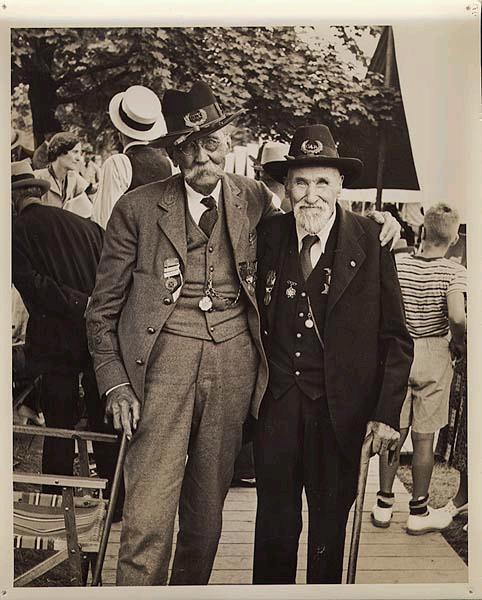
NSA Update.
A little while ago we noted that a bill to curb significantly NSA's ability to bulk collect telephone metadata in the U.S. had passed the House of Representatives and was on its way to the Senate where it looked good but Leader McConnell opposed it. Well, Leader McConnell has had a tiger by the tail since becoming Leader and the bill has hit the airpump. The Senate can't pass it but this is good! The original section of the Patriot Act authorizing the bulk collection "sunsets" on June 1 meaning out of bidness, the whole shebang! Heh-heh-heh-heh. And the senators have left Washington. Heh-heh-heh-heh. "Why don't YOU have a drink with Mitch McConnell?" Heh-heh-heh-heh.
Friday, May 22, 2015

With the graves as background and everything. Jesus Christ. You would not believe this if someone showed you a pic cold. Or video. Nah: actors, photoshopped; Bullshit, didn't happen. Guess what is going to be the posting theme for Monday, Memorial Day?
We're going to start off precisely at midnight with Oliver Wendell Holmes, Jr.'s 1884 Memorial Day address. I have reprinted that a number of times and have also posted my popular learned commentary a number of times. I'm going to let Holmes speech stand unpolluted by my own thoughts and then separately post excerpts avec commentary, not the same old same old, New! Improved! commentary more relevant to the posts of the last couple days. Until manana, good night Johnny Reb, good night Billy Yank...Damnedest thing I ever saw.
Was it not real? Define "real."
This is the most I've ever written about the Civil War in one stretch which means it's the most I've thought about the Civil War at one stretch and you can see the evolution in my thinking in the writing. I am now at the stage on the evolutionary timeline marked: amazement.
There is no rational explanation for the manner in which the American people conducted the Civil War and then conducted the post-war peace and when rationality fails we are drawn to the irrational.
Combining the words of Nabokov and Holmes it is as if the hearts of the American people are touched by a divine fire, that that fire purified and was Godsent. I use the present tense in the first clause of that last sentence because I hope we are and think we may be.
I am too aware that I have leapt from 1865 to 1913 and leapt over the human, all too human, Reconstruction period with all of its failings. American Reconstruction is what we would expect of mere humans, it is unexceptional, comprehensible through reason, I do leap over that which is capable of human understanding to that which is not.
Civil wars are a dime-a-dozen in human history, they were especially so in the century just past. There is not one of those things in human history that was fought as this one was fought and whose wounds were healed as this one's were.
There is no rational explanation for the manner in which the American people conducted the Civil War and then conducted the post-war peace and when rationality fails we are drawn to the irrational.
Combining the words of Nabokov and Holmes it is as if the hearts of the American people are touched by a divine fire, that that fire purified and was Godsent. I use the present tense in the first clause of that last sentence because I hope we are and think we may be.
I am too aware that I have leapt from 1865 to 1913 and leapt over the human, all too human, Reconstruction period with all of its failings. American Reconstruction is what we would expect of mere humans, it is unexceptional, comprehensible through reason, I do leap over that which is capable of human understanding to that which is not.
Civil wars are a dime-a-dozen in human history, they were especially so in the century just past. There is not one of those things in human history that was fought as this one was fought and whose wounds were healed as this one's were.
Thursday, May 21, 2015
It does not seem real


Heh-heh-heh-heh. North and South contemplating Pickett's Charge at the stone wall. "How DID we do that?" "I'on't know."
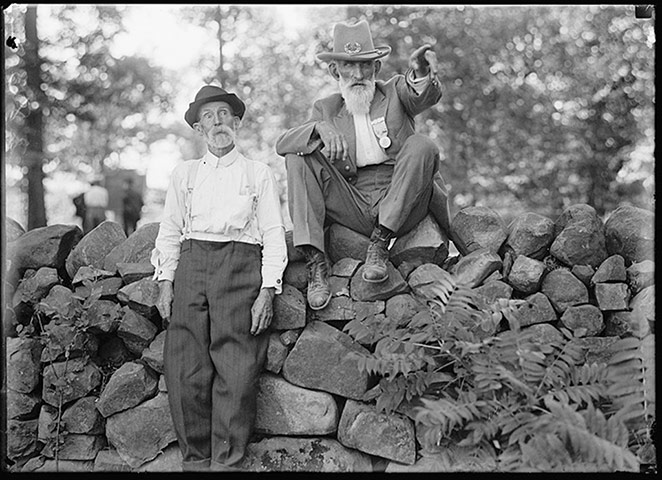
"We was right over yonder, see?" "Ohhh." Heh-heh-heh-heh. A Johnny Reb explaining Pickett's Charge to a Billy Yank.
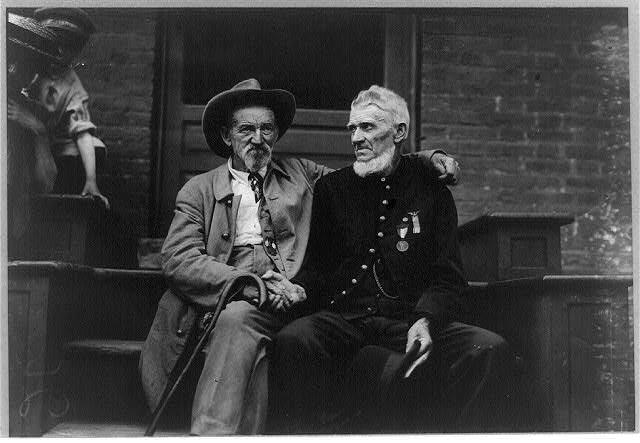

I've felt in the last few days like Yosemite Sam in one of the Bugs Bunny cartoons, Bugs gets the drop on Sam again and Sam says, "I don't know how's ye did it but I knows ye did it!" I know the Civil War generation did it--fought a war, killed each other dead, held an election in the middle of the war, assassinated the election's victor, ended the war, ended slavery, ended secession, restored the Union, bound up the nation's wounds, made the United States a singular noun--but I don't know how they did it. It does not seem humanly possible.
Lincoln gave an ethereal view of the war in his second inaugural: he blamed both sides, the South for perpetrating slavery, the North for permitting it. He came to see slavery almost as a birth curse--It was in the Constitution!--that was almost beyond his, or any mortal man's, power to get rid of without killing that which was born with it. "Fervently do we pray that the scourge of war shall pass away," yet, if God willed that every drop of blood drawn by the bondsman's lash shall be repaid drop-for-
drop, "the judgments of the Lord are true and righteous." Lincoln was a lawyer, there had to be justice
paid for slavery!, and the Lord had a terrible swift sword to administer justice. To both sides.
There was, or there came to be, in Abraham Lincoln's mind, in the minds of enough Northerners, an other-worldly purpose to the Civil War beyond the original purpose, restoration of the Union; there came to be, in Frederick Douglass' phrase "something beyond the battlefield," the war became God's will, however it was to turn out and at whatever cost, it would be God's will, and we, they, were merely the instruments working God's will and ignorant of His purpose.
Maybe that is explanation for the sound of Lincoln's second inaugural: ethereal, above it all, detached, God-like; for the peculiar, detached, duty-bound actions of Andrew Atkinson Humphreys, of Henry Abbott, of so many others in battle; for their inspiration also. For if you see yourself as barely comprehending theater set piece acting a part, directed by an omniscient one, then you do your duty and beyond your capabilities, you do it with the serenity that detachment provides. It's your duty, it's your role, it's your job, you just work here on earth, it's just business, it's nothing personal, I just have to kill you, it's my job, yours is to die, we will always be friends. Perhaps that too is explanation for the magnanimity in Lincoln's second inaugural and for the post-war reunions. Did it not seem real, though?
Wednesday, May 20, 2015
Was it not real?

The momentous meaning of this occasion impressed me deeply. I resolved to mark it by some token of recognition, which could be no other than a salute of arms...The act could be defended, if needful, by the suggestion that such a salute was not to the cause for which the flag of the Confederacy stood, but to its going down before the flag of the Union. My main reason, however, was one for which I sought no authority nor asked forgiveness. Before us in proud humiliation stood the embodiment of manhood: men whom neither toils and sufferings, nor the fact of death, nor disaster, nor hopelessness could bend from their resolve; standing before us now, thin, worn, and famished, but erect, and with eyes looking level into ours, waking memories that bound us together as no other bond;—was not such manhood to be welcomed back into a Union so tested and assured? Instructions had been given; and when the head of each division column comes opposite our group, our bugle sounds the signal and instantly our whole line from right to left, regiment by regiment in succession, gives the soldier's salutation, from the "order arms" to the old "carry"—the marching salute. [Confederate General John Brown] Gordon at the head of the column, riding with heavy spirit and downcast face, catches the sound of shifting arms, looks up, and, taking the meaning, wheels superbly, making with himself and his horse one uplifted figure, with profound salutation as he drops the point of his sword to the boot toe; then facing to his own command, gives word for his successive brigades to pass us with the same position of the manual,—honor answering honor. On our part not a sound of trumpet more, nor roll of drum; not a cheer, nor word nor whisper of vain-glorying, nor motion of man standing again at the order, but an awed stillness rather, and breath-holding, as if it were the passing of the dead!
— Joshua L. Chamberlain, The Passing of the Armies, pp. 260-61

In time, even death itself might be abolished; who knows but it may be given to us after this life to meet again in the old quarters, to play chess and draughts, to get up soon to answer the morning role call, to fall in at the tap of the drum for drill and dress parade, and again to hastily don our war gear while the monotonous patter of the long roll summons to battle.
Who knows but again the old flags, ragged and torn, snapping in the wind, may face each other and flutter, pursuing and pursued, while the cries of victory fill a summer day? And after the battle, then the slain and wounded will arise, and all will meet together under the two flags, all sound and well, and there will be talking and laughter and cheers, and all will say, Did it not seem real? Was it not as
in the old days?-Berry Benson, Memoirs of a Confederate Scout and Sharpshooter.

CSA septuagenarians reenacting Pickett's Charge to moans and gasps of Union veterans,

meeting again at the stone wall, and shaking hands. Gettysburg, 1913.

American "exceptionalism" began with the Civil War: an election held right in the middle of the war; vicious fighting for four years, assassination, unparalleled magnanimity at the end; reconstruction; "binding up the nation's wounds" "with malice toward none;" the enemy reunions; the election of a Southerner, a Virginian, Woodrow Wilson, as president only forty-eight years after Appomattox.
General Joshua Lawrence Chamberlain, "The Fighting Professor," who extended a final salute to, and received the final salute back from, General John Brown Gordon at Appomattox, called the Great Reunion "transcendent" moment. That is the word! During the Civil War Americans transcended the human and achieved an other-worldly grace.
"Did it not seem real?" It did not seem real even to those who knew that it was real because they were there. That was the birth of American exceptionalism and that birth certificate is real.
Subscribe to:
Posts (Atom)


